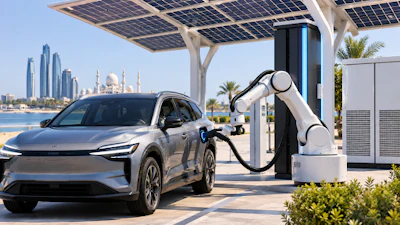

BYD has unveiled an advanced megawatt charging system in Abu Dhabi that combines 1000+ kilowatt ultra-fast charging, robotic charging arms, solar panels, and battery storage to enable compatible electric vehicles to charge from 10 to 70 percent in approximately five minutes, with plans to expand to at least 6000 FLASH Charging stations worldwide by 2027.
- BYD's FLASH Charging technology delivers over 1000 kilowatts of power, enabling compatible vehicles to charge from 10-70% in roughly five minutes
- The Abu Dhabi facility features robotic charging arms that automatically open vehicle charging ports and connect cables without driver intervention
- The system integrates solar panels and stationary battery storage to capture daytime energy for charging operations
- BYD plans to establish at least 6000 FLASH Charging stations outside China by end of 2027, marking major international expansion
- Collision repairers must understand inspection and testing requirements for sophisticated charging systems, as damage to ports, cables, and cooling components affects charging performance and vehicle safety
Plugging in an electric vehicle could soon become a thing of the past, at least for drivers using BYD's latest charging technology.
The Chinese automaker has unveiled a new charging installation in Abu Dhabi that combines solar power, battery storage, automated charging equipment and ultra-fast charging speeds exceeding 1,000 kilowatts.
The facility brings together several technologies that BYD has been developing as part of its effort to make electric vehicle charging faster and more convenient.
One of the most interesting features is a robotic charging arm that automatically opens the vehicle's charging port and connects the charging cable.
The system also incorporates solar panels and stationary battery storage, allowing electricity generated during daylight hours to be stored and used for vehicle charging.
At the centre of the installation is BYD's FLASH Charging technology, which can deliver charging power of 1,000 kW or more.
According to the company, compatible BYD vehicles can recharge from 10 to 70 per cent in approximately five minutes under suitable conditions.
That brings charging times closer to a conventional gasoline fill-up, although performance depends on the vehicle's battery and charging capabilities.
BYD is planning a major international expansion of its FLASH Charging network, targeting at least 6,000 stations outside China by the end of 2027.
It remains unclear how many of those locations will incorporate the complete solar, storage and robotic charging system demonstrated in Abu Dhabi.
While megawatt charging may seem far removed from day-to-day collision repair operations, the technology points to another area of growing complexity for Canadian EV repairers.
Higher charging power places greater demands on battery thermal management, electrical connections and charging components.
Following a collision, damage to charging ports, high-voltage cables, cooling systems or related electronics could have implications for charging performance and vehicle safety.
Automated charging systems may also require precise positioning and undamaged charging-port assemblies to function correctly.
Canadian repair facilities will need to understand the inspection and testing requirements for increasingly sophisticated charging systems, particularly as higher-powered charging technology becomes more common.
For repairers, the issue isn't simply how quickly a vehicle can charge. It's knowing how to confirm that the charging system remains safe and operates as intended after a collision.