
In the early 1920s, shortly before Regina Auto Body Shop Ltd. opened its doors, collision repair wasn’t about fixing vehicles; instead, the business began by repairing milk wagons. “There used to be a creamery right across the street from us that delivered milk with horse-drawn wagons that were top-heavy, so when they would go down the streets, those wagons would often tip over, and the doors would get misaligned,” said Mike Mario, managing partner and co-owner of RAB. “There was a blacksmith shop here, so they would drag the wagon over, get the doors working, shoe the horses and send them out on the road again.”
Then, automobiles came around, and Russ Karels opened RAB in 1924, marking the first dedicated collision repair shop in Western Canada. Those early days were spent performing repairs because there wasn’t a need to replace parts; therefore, metal was straightened instead of replaced.
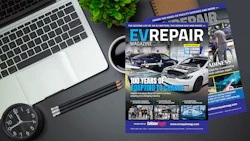
RAB has been in service since 1924 and recently celebrated its 100th anniversary in June 2024. The third-generation family business is the only Tesla approved collision centre in southern Saskatchewan and is run by Mike and his nephew, managing partner and co-owner Chad Mario, along with Mike’s son, Matt Mario and Kaylyn Hildebrand and Sheldon Terry.
Over the century, RAB has navigated key technological shifts, beginning in the late 1950s when it was one of the first repair facilities to have a drive-through spray booth leading into a bake oven. Fitted with a series of heat bulbs, the bake oven had a bank of lights that moved back and forth over a freshly painted vehicle to cure the paint more quickly.
The early 1980s were a tipping point for the industry, when the 3M ARMS management system introduced RAB to the world of job costing. “We really got to know our costs and how we can be a successful collision repair shop,” said Mike. “The networking within the 3M ARMS seminars really got us linked in to other people across the country, which helped us succeed.”
In the late ‘80s, MIG welders were introduced to the collision repair industry. “We had to use MIG welders to weld panels on instead of the old oxyacetylene, and that was quite a change,” Mike told EV Repair magazine.
Today, ADAS, calibration equipment and pre- and post-repair scans take centre stage. RAB’s continual adaptation to change has taught the shop a valuable lesson — stay true to the customers. “We owe our 100-year history to loyal customers,” said Mike. “To keep them satisfied, we continuously evolved right alongside the cars they drive.” Mike credited RAB’s 100-year survival to customer loyalty, stating that adapting to evolving vehicle technology was essential to meeting client expectations.
That commitment to customer satisfaction shows: RAB boasts a stellar 4.9/5-star rating across 746 Google reviews. Alongside its outstanding reputation, the shop holds elite industry credentials, including I-CAR Gold Class recognition and official SGI accreditation. Propelling this momentum forward, Mike, Chad, Matt, Kaylyn and Sheldon recently expanded their operations by purchasing a second location in Weyburn, officially stepping into the role of a multi-store owner.
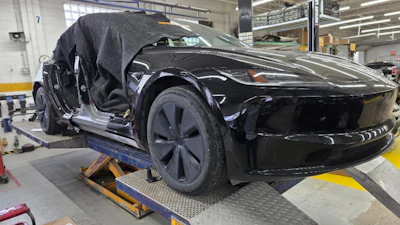
But RAB’s claim to fame is its Tesla certification, a credential the shop earned in 2018.
“It was a big talk back then, about how Tesla was growing in the United States and people buying them in Vancouver and Toronto. So, we just thought we would jump on it,” said Mike. “There were fewer than 100 [Teslas] in the province, and after much research and the fact that we could be the only approved repair shop in southern Saskatchewan, we took the risk and haven’t looked back.” Now, RAB averages three or four Teslas brought in every week.
In addition, the tooling Tesla required, such as computers with high-speed internet, applied to other OEM certifications as well. It was the biggest investment RAB made to become EV-ready, but that investment paid off; the shop currently has 16 OEM certifications. On top of that, RAB’s technicians spent at least eight hours each in an online training program to qualify as Tesla-approved technicians.
According to Mike, those Tesla-approved technicians need to be able to safely handle high voltage and be computer savvy. Fortunately, RAB’s technicians embraced that. “We had, and we still do have, younger techs who caught on rather quickly to this. They were excited to do something different, rather than just fixing a normal car,” said Mike. “Teslas are basically computers on wheels.” Regina Auto Body Shop claim to fame is its Tesla certification, a credential the shop earned in 2018.
Yet, servicing EVs presents challenges, including the danger of high-voltage batteries and how to maintain battery life. “Repairs require advanced software diagnostics,” stated Mike. “So that’s huge to try to figure out what the issue with this vehicle is. Why can’t we get it running? Why are these [warnings] coming up on the computer screen and within the car?”
The EV market in Saskatchewan differs from that in larger urban centres such as Vancouver and Toronto. “It gets so cold here — minus 40 sometimes — and the batteries can go dead very quickly compared to if it’s around the zero mark,” said Mike. “We have three areas where there’s rapid charging in our building to charge the EVs up quicker, just because of that.” However, in a more rural province like Saskatchewan, the smaller number of EVs makes it tougher to get parts, with repairers seeing a three- to four-day delay when ordering parts from bigger centres out of province.
Mike encourages collision repairers preparing for the future to embrace change. “Be resilient to whatever changes may come your way. Always keep the customer in mind in your decision-making,” he said. Recalling the words of the late Larry Jefferies, co-founder of CARSTAR Canada, Mike concluded, “A wise man told me years ago, ‘things change because things change.’”