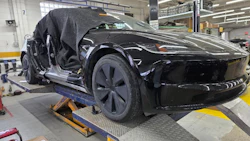
The damaged bumper didn’t look serious. At first glance, neither did the estimate. Ten years ago, that might have been enough. A technician could identify the obvious damage, write an estimate, order the parts and begin repairs, knowing that any hidden damage would be addressed through supplements along the way. Today’s electric vehicles don’t afford that luxury. What appears to be a straightforward repair can quickly become far more involved once battery protection structures, high-voltage wiring, cooling systems or advanced driver assistance systems enter the equation. A seemingly minor collision may trigger battery inspections, diagnostic scans, sensor calibrations and OEM-prescribed safety procedures before the first repair operation even begins.
That shift has fundamentally changed the purpose of blueprinting. It is no longer simply an estimating exercise designed to improve efficiency or reduce supplements. It has become the foundation for every safe, efficient and profitable EV repair. The quality of the repair plan developed at the outset often determines everything that follows, from cycle time and profitability to technician productivity and, ultimately, whether the vehicle can be returned safely to its pre-accident condition.
The industry’s leading EV repair facilities have recognized that the traditional estimating process no longer reflects the complexity of modern vehicles. Rather than writing an estimate and refining it as repairs progress, they are investing more time at the beginning of every repair to develop a comprehensive blueprint. That means consulting OEM repair procedures before labour operations are added, performing controlled disassembly where required, conducting diagnostic scans and documenting every operation that can reasonably be identified before production begins. Although the process requires more effort upfront, the payoff is significant. Fewer interruptions, better scheduling, more accurate parts ordering and fewer unnecessary supplements all contribute to a smoother repair and a healthier bottom line.
One of the biggest adjustments shops make when they begin repairing electric vehicles is learning not to rely on first impressions. Exterior damage tells only part of the story. Beneath a damaged quarter panel, rocker panel or front bumper may be battery protection structures, high-voltage cables, cooling components or ADAS sensors that require careful inspection before repair decisions can be made. Even relatively low-speed impacts can activate manufacturer inspection procedures extending far beyond the visibly damaged panel.
The question has shifted from “What needs to be repaired?” to “What do we need to know before deciding how this vehicle should be repaired?” That distinction changes everything. Controlled disassembly becomes part of the blueprint rather than an unexpected source of supplements. Diagnostic scans become investigative tools instead of paperwork completed after repairs are finished. Every component removed and every inspection completed provides information that strengthens the repair plan before technicians begin work.
OEM repair procedures now sit at the centre of that process. Manufacturers have always published repair information, but electric vehicles have elevated those procedures from useful references to essential operating documents. Battery construction, high-voltage architecture and structural repair requirements vary from one manufacturer to another and often between model years. Some OEMs require battery isolation before repairs begin. Others mandate inspections after relatively minor impacts or prohibit certain repair methods near high-voltage components.
 A technician inspects an EV under the hood, demonstrating the detailed assessment required when blueprinting modern vehicles for repair.
For repair planners, this means OEM procedures must drive the estimate rather than simply support it. Instead of relying solely on estimating software or previous experience, today’s blueprint begins with current manufacturer documentation. Labour operations, inspections and calibrations are identified because the OEM requires them, not because they are discovered halfway through the repair. That approach protects technicians, produces more consistent repairs and provides insurers with documented justification for necessary operations.
Electronic diagnostics have become equally important because they reveal information that cannot be identified through visual inspection alone. Pre-repair scans often uncover fault codes involving battery systems, occupant protection systems or ADAS components that require additional investigation. Those scans establish a baseline, documenting the vehicle’s condition before repairs begin and helping technicians verify that systems are functioning correctly once repairs are complete.
Planning for post-repair diagnostics and calibrations during the blueprinting stage is equally important. Rather than treating these operations as final checklist items, leading shops build them into the repair plan from the beginning. Calibration appointments can be scheduled earlier, production delays are reduced and required procedures are far less likely to be overlooked.
Despite advances in repair planning, supplements remain a reality. Hidden damage cannot always be identified during initial disassembly, particularly as vehicle construction becomes more sophisticated. The objective of blueprinting has never been to eliminate every supplement. It is to eliminate the avoidable ones. Thorough planning identifies the majority of required operations before repairs begin, allowing parts to be sourced earlier, specialized equipment to be scheduled and insurers to receive more complete documentation from the outset.
The financial impact extends well beyond the estimate itself. Technicians spend more time repairing vehicles instead of waiting for approvals. Production managers gain confidence when scheduling work because fewer surprises interrupt the repair process. Customer service staff provide more accurate delivery dates because they are working from a complete repair plan instead of educated assumptions. In an industry where every day counts, that predictability becomes a competitive advantage.
Blueprinting has also evolved into a team effort. In many leading collision centres, repair planning now involves estimators, structural technicians, diagnostic specialists, production managers and OEM-certified personnel working together before repairs begin. Each contributes expertise that strengthens the final repair plan and reduces the likelihood of costly disruptions later in production.
 A technician uses digital tools to assess an EV, highlighting the importance of thorough blueprinting before repairs begin.
Technology continues to support that collaboration. Artificial intelligence, digital inspection platforms, integrated estimating systems and electronic repair documentation have improved the speed and consistency of blueprinting while helping organize increasingly complex repair information. Technology, however, cannot replace experience. Skilled repair planners understand repair sequencing, recognize subtle structural indicators and know when further investigation is warranted. Software provides information. Experienced professionals provide the judgment needed to apply it correctly.
The collision repair industry has long believed that every successful repair begins with a good estimate. Electric vehicles have rewritten that assumption. Today, every successful repair begins with a comprehensive blueprint that combines OEM procedures, diagnostics, controlled disassembly and informed decision-making into a single repair strategy. The blueprint no longer documents the repair. It defines it.
As electric vehicles continue to reshape the collision industry, the shops that stand apart won’t necessarily be those with the newest equipment or the largest facilities. They’ll be the ones that understand the repair is often won or lost before the first fastener is removed. Mastering blueprinting has become more than an operational advantage. It has become one of the defining characteristics of a professional EV repair facility.