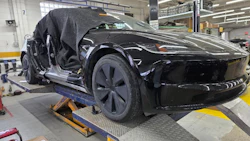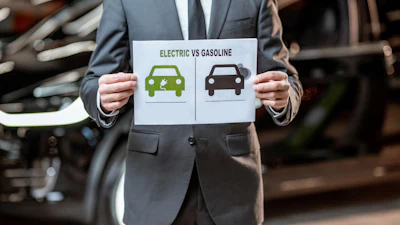
Electric vehicles still carry a collision repair premium, but that premium is getting smaller.
Mitchell’s latest Canadian claims data puts average repairable severity for a battery electric vehicle at $6,645 during the second quarter of 2026. Internal combustion engine vehicles averaged $5,411. That $1,234 difference is the smallest Mitchell has recorded in Canada.
For repairers already working on EVs, that may be more interesting than another debate about whether electric vehicle adoption is moving fast enough.
EV collision repair is beginning to mature.
Some of what made early EV collision numbers stand out came from the vehicles themselves. Early adopters often drove relatively expensive vehicles packed with technology. Parts options were limited, repair experience was still developing and virtually everything about EV collision repair was new.
That picture is changing. More mainstream EVs have entered the fleet, repairers have accumulated experience and the vehicles themselves are getting older.
Mitchell suggests a maturing EV fleet and higher total loss frequency may be contributing to repair costs moving closer to those of internal combustion engine vehicles.
Look at the change from one quarter to the next. Canadian BEV repairable severity averaged $7,185 in the first quarter of 2026. Three months later, it stood at $6,645. ICE severity moved from $5,605 to $5,411 over the same period.
One quarter doesn’t establish a long-term trend, but it does raise an interesting question. What does EV collision repair look like once it stops being unusual?
Repair facilities may already be finding out.
BEVs represented a record 5.42 percent of repairable Canadian collision claims during the second quarter, up 12.4 percent year over year. Mild hybrids accounted for 5.52 percent and plug-in hybrids another 1.85 percent.
That growing volume matters. More vehicles mean more estimates, more repairs and more opportunities for repairers, insurers and suppliers to learn what actually drives cost.
It also means averages become more meaningful. A market made up of a relatively small number of expensive vehicles can produce very different numbers than one containing everything from premium EVs to mainstream crossovers and pickups.
None of this means EV and ICE repairs have suddenly become interchangeable.
Parts remain one of the clearest differences. BEVs remain much more dependent on OEM replacement parts, according to Mitchell, and typically have fewer parts repaired rather than replaced. That leaves EV repairs particularly exposed to changes in parts prices, availability, tariffs and global supply chains.
Technology adds another layer.
Mitchell reported that BEVs averaged 1.70 calibrations per estimate in 2025, compared with 1.63 for hybrids and 1.54 for ICE vehicles. Dense electrical architecture, interconnected systems and sensor-heavy designs continue to add diagnostic and calibration operations to collision repairs.
Experienced EV repairers know those operations aren’t optional extras. They are part of returning the vehicle to pre-accident condition.
Yet there is another side to the cost equation that deserves attention. As repairers perform more EV work, processes become familiar. Training investments have already been made. Equipment gets used more frequently. Estimators learn where to look. Technicians know where procedures differ. Repair planners become better at identifying operations before the vehicle reaches production.
None of those things makes the vehicle less complex, but experience matters.
There is also a changing economic calculation surrounding total losses.
Canadian BEV total loss market values fell 13 percent in 2025, the largest decline among the powertrain categories Mitchell tracked. Accelerated depreciation, lower-cost models entering the market and changing consumer sentiment all contributed.
That creates an interesting tension. Repair knowledge is improving at the same time the value of some used EVs is declining. A technically repairable vehicle can still become an economic total loss when repair cost runs into a falling actual cash value.
For collision repairers, that could become one of the defining issues of the next stage of EV repair.
More EVs are entering the repair stream. Shops are becoming better at fixing them. Repairable severity is moving closer to ICE vehicles. Yet an ageing fleet means more of those vehicles will arrive with lower pre-collision values.
Repair-versus-replace decisions could get more interesting before they get easier.
What seems increasingly clear is that EV collision repair is moving into a different phase. Early conversations focused heavily on whether repair facilities could handle high-voltage vehicles safely. That work isn’t finished, but qualified EV repairers have moved well beyond that question.
Now come the business questions.
How efficiently can the vehicle move through production? How available are the parts? How much OEM content will the estimate require? How many diagnostic and calibration operations are involved? What is the vehicle worth? At what point does a perfectly legitimate repair stop making financial sense?
Those are familiar collision repair questions applied to a different powertrain.
Perhaps that is the biggest sign of progress.
EV collision repair is becoming less about EVs being different and more about understanding exactly where those differences still matter.