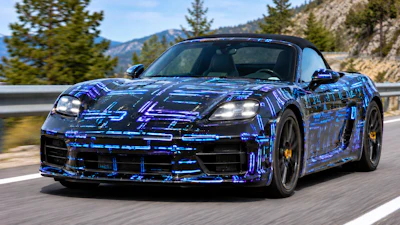
Porsche's first all-electric 718 Boxster is nearing the end of its development program, with the automaker preparing to introduce its electric sports car in the first quarter of 2027.
The electric Boxster has undergone approximately four million kilometers of testing across more than 20 countries, including extreme cold in Sweden and high temperatures in Death Valley. Porsche also evaluated the vehicle in urban traffic, at varying elevations and using five different charging standards.
The vehicle features an 800-volt battery architecture positioned directly behind the seats, an arrangement Porsche calls its E-Core layout. The design aims to preserve the weight distribution and driving characteristics associated with the traditional mid-engine Boxster, while allowing for a low seating position.
Porsche says the electric Boxster will have a 40 per cent front and 60 per cent rear weight distribution, with all models featuring rear-wheel drive. Chassis components, steering technology, braking systems and wheel and tire dimensions draw from the automaker's 911 lineup.
The top-of-the-range version is expected to accelerate from zero to 100 km/h in less than three seconds and reach a top speed exceeding 250 km/h.
The electric sports car will also feature Porsche's E-Shift system, which simulates a seven-speed PDK transmission. Drivers can use steering-wheel-mounted paddles to select simulated gears, while the system incorporates simulated engine sound based on the six-cylinder boxer engine from the 981-generation Boxster GTS.
When E-Shift is deactivated, the paddles instead control three levels of regenerative braking.
Porsche says the new electric 718 Boxster will be built at its Stuttgart-Zuffenhausen plant, with the production model scheduled to make its debut in the first quarter of 2027.
The development represents another step in Porsche's transition toward electrification, with the company attempting to retain the handling, performance and driving experience associated with its established sports-car lineup.
The electric Boxster's 800-volt architecture and compact battery placement highlight how EV platforms continue to evolve, even among vehicles designed around performance rather than mass-market efficiency. For collision repairers, new vehicle architectures reinforce the importance of following model-specific OEM procedures for structural work, high-voltage isolation, battery-related damage assessment and post-repair verification. As more high-performance EVs enter the fleet, specialized repair requirements will continue to shape training, equipment and repair planning.