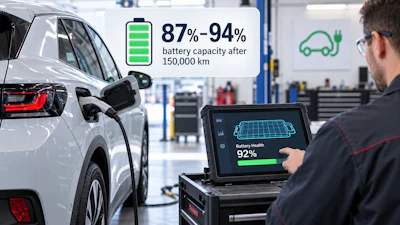

A global study by Austrian company Aviloo tested over 500,000 batteries across 20 EV models and found that electric vehicles retain between 87 and 94 percent of their original battery capacity after 150,000 kilometers, suggesting that common concerns about battery degradation may be overstated.
- Aviloo conducted over 500,000 battery health tests on 20 popular EV models between 2022 and 2026
- EVs retain 87-94% of original battery capacity after 150,000 kilometers of driving
- Battery health varies significantly between identical vehicles due to climate, driving habits, charging behavior, and battery size
- Top performers included the Hyundai IONIQ 5 at 93.79% capacity after 150,000km, while the second-generation Nissan LEAF averaged 86.67%
- Individual battery testing is essential for determining vehicle condition and value, especially as more EVs enter the used vehicle market
Concerns about battery degradation remain one of the biggest questions surrounding electric vehicles, but new real-world data suggests those concerns may be overstated.
A global study by Austrian battery diagnostics company Aviloo found that EVs retain between 87 and 94 per cent of their original battery capacity after 150,000 kilometres. The company reached the conclusion after conducting more than 500,000 battery health tests on 20 popular EV models between 2022 and 2026.
The results also show that battery health can vary significantly between vehicles, even when they are the same make and model.
Across the vehicles studied, median battery state of health ranged from 91 to 97 per cent after 50,000 kilometres and from 88 to 95 per cent after 100,000 kilometres. Aviloo found an 11-percentage-point spread among the Tesla Model Ys it tested, with even greater variation recorded among Volkswagen ID.4 and Hyundai IONIQ 5 models.
For Canadian EV owners, the Hyundai IONIQ 5 showed particularly strong results. Vehicles in the study averaged 93.79 per cent of their original battery capacity after 150,000 kilometres. At the other end of the range, second-generation Nissan LEAF batteries averaged 86.67 per cent, while the first-generation MINI Cooper SE averaged 87.11 per cent.
The findings highlight an increasingly important role for battery diagnostics as EVs move further into the aftermarket.
Mileage alone does not tell the complete story of an EV battery. Climate, battery size, driving habits and charging behaviour can all affect degradation, meaning two otherwise identical vehicles can have noticeably different battery health.
For collision repairers, recyclers and other businesses dealing with used EVs, that variability makes accurate battery health information increasingly valuable. A vehicle's state of health can help provide a clearer picture of the condition and potential value of the vehicle beyond what can be determined from mileage alone.
Aviloo CEO Marcus Berger also stressed that individual testing is necessary to determine where a particular vehicle falls within the range.
The message is not that EV batteries do not degrade. They do. Rather, the latest real-world data suggests degradation is generally slower than some early concerns suggested, while also demonstrating why understanding the condition of an individual battery is becoming increasingly important as the EV population ages.