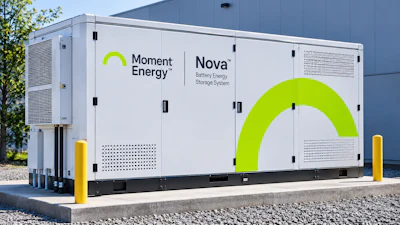
A Canadian battery technology company has begun production of a commercial energy storage system built using repurposed electric vehicle batteries, marking a milestone for second-life battery applications.
Moment Energy's Nova battery energy storage system (BESS) has earned UL 1973 and UL 9540 certifications, making it the first system built using repurposed EV batteries to achieve both certifications, according to the company. The system is designed for commercial and industrial applications, including hospitals, airports and manufacturing facilities.
Manufactured at Moment Energy's facility in Surrey, B.C., each Nova unit delivers 200 kW of power and 500 kWh of storage capacity. Multiple units can be combined to support larger installations.
The system uses batteries removed from electric vehicles that have reached the end of their automotive service life but still retain capacity for stationary energy storage. Battery condition is monitored through an AI-supported system designed to account for differences in the performance and remaining capacity of individual battery packs.
Safety certification is a key milestone for the technology. Nova has received UL 1973 certification for battery safety and UL 9540 certification for energy storage systems, along with testing under UL 9540A, which evaluates thermal runaway fire propagation.
Additional safety features include liquid cooling, heat and smoke detection, flammable gas detection and an integrated explosion prevention system. The modular design also allows individual battery packs to be replaced without requiring the entire storage system to be removed.
Moment Energy expects the system to provide a service life of more than 20 years, with the first commercial deliveries scheduled for early 2027.
The development highlights the expanding role of EV batteries beyond vehicle applications and the growing importance of evaluating, repurposing and managing batteries once they are no longer suitable for automotive use.
The growth of second-life battery applications reinforces the importance of accurate battery condition assessments following vehicle damage or the end of a battery's automotive service life. Collision repairers may increasingly encounter questions about whether a damaged battery can be repaired, reused, repurposed or must be recycled. Understanding battery assessment procedures, documentation and safe handling will become increasingly important as the market for repurposed batteries develops.