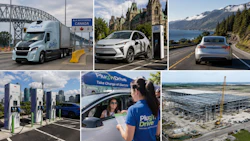
A battery rebalancing trial increased an EV's range by 101 kilometers without replacing the battery pack, FedEx ordered 2,000 electric trucks for Canadian and U.S. operations, and Canadian autonomous driving technology is now hauling customer freight between Dallas and Houston.
- Battery X Metals' rebalancing trial increased one vehicle's estimated range from 240 km to 341 km, a 42% increase, by reducing cell voltage differences from 41 mV to 4 mV.
- FedEx placed a US$300 million order for 2,000 electric trucks from Harbinger, with deliveries scheduled by end of 2027 for Canadian and U.S. operations.
- Waabi's autonomous driving system equipped Volvo VNL trucks are now serving Warp, a freight network, hauling full-truckload and consolidated shipments on the Dallas–Houston corridor.
- Ontario expanded its R&D Partnership Fund to support autonomous and electrification technology development for defence, public safety, and space applications.
- Kodiak AI launched autonomous refrigerated and dry freight service on a 700-km Dallas-to-Laredo route, with driverless operations planned after safety evidence is completed.
In this week’s EV/AV report, a battery-rebalancing trial has produced higher estimated range, electric delivery trucks are heading to Canada and Canadian autonomous-driving technology is hauling customer freight in Texas.
Restoring range
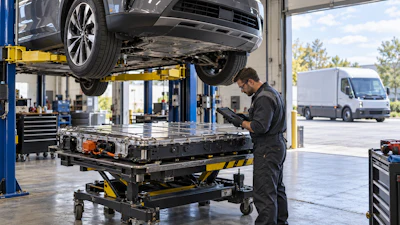
An EV battery rebalancing trial has increased one vehicle’s displayed range estimate by 101 km without replacing its battery pack.
Vancouver-based Battery X Metals, a battery technology developer and mineral exploration company, announced the results on October 9.
An overseas automotive service centre tested technology developed with Beijing Pengneng Science & Technology.
The vehicle’s estimated range rose from 240 km to 341 km, a 42% increase. The difference between the highest and lowest cell voltages fell from 41 mV to 4 mV after treatment and a four-hour stabilization period.
Rebalancing aims to recover capacity lost when cells develop different charge levels. It does not repair every cause of battery deterioration.
These were dashboard range estimates, not distances established through a driving test. Battery X has not independently verified the results, which cover one vehicle.
Electric delivery expansion
Canadian delivery operations have been included in a FedEx order for 2,000 electric trucks worth more than US$300 million.
California-based Harbinger, a manufacturer of medium-duty electric vehicles and battery systems, announced the order on October 1. Deliveries are scheduled by the end of 2027 for FedEx pickup and delivery operations across Canada and the United States.
The trucks will replace conventional vehicles. The order includes several models, but neither the Canadian allocation nor deployment locations have been announced.
Kaizen Automotive Group, Harbinger’s Canadian dealer, will support the Canadian portion of the rollout.
Freight on the road
Autonomous trucks using Canadian technology have begun hauling customer freight directly between facilities in Texas.
Waabi, a Canadian autonomous-driving developer, and Volvo Autonomous Solutions announced their first joint customer operation on October 5. Volvo VNL Autonomous trucks equipped with Waabi’s driving system are serving Warp on the Dallas–Houston corridor.
Warp coordinates full-truckload freight and smaller shipments consolidated from several customers. The operation moves autonomy into a freight network with multiple shippers and tightly scheduled deliveries.
The trucks have redundant systems for six safety-critical functions. An observer remains in the driver’s seat.
“The value of autonomy grows when you can coordinate the freight around it,” said Daniel Sokolovsky, Warp’s chief executive.
Ontario funding opens
Ontario mobility developers have gained access to a funding stream for adapting autonomous and electrification technologies to defence, public safety and space applications.
The Ontario Vehicle Innovation Network announced the expansion of its R&D Partnership Fund on October 6. Applications opened October 7.
The network is a provincial automotive and mobility initiative led by the Ontario Centre of Innovation. Eligible projects include the development, testing and demonstration of autonomous systems, electrification, propulsion, sensors and satellite-based positioning.
In this week’s EV/AV report, a battery-rebalancing trial has recorded higher estimated range, an electric-truck order includes Canadian deployment and Ontario has expanded funding for mobility technology.
Battery balance
An EV battery-rebalancing trial has increased one vehicle’s estimated range by 101 km without replacing the pack.
Vancouver-based Battery X Metals, a battery technology developer and mineral exploration company, announced the results on 2026-10-09. An overseas automotive service centre conducted the evaluation. Beijing Pengneng Science & Technology, a Chinese battery-rebalancing hardware and software developer, supplied the results.
The vehicle’s displayed range estimate rose from 240 km to 341 km, a 42% increase. The difference between the highest and lowest cell voltages fell from 41 mV to 4 mV after treatment and a four-hour stabilization period.
The technology aims to recover usable capacity lost through cell imbalance, potentially avoiding premature pack replacement.
“The Company has not independently verified the Results,” was the qualification included in the release.
The findings cover one vehicle. They reflect vehicle-generated range estimates, not measured driving distances.
Electric deliveries
Canadian delivery operations have been included in an order for 2,000 electric trucks worth more than US$300 million.
FedEx, the Memphis, Tenn.-based parcel and freight carrier, placed the order with Harbinger, a medium-duty electric-truck manufacturer based in Garden Grove, Calif. The announcement was dated 2026-10-01.
Deliveries are planned by the end of 2027 for Canadian and U.S. pickup and delivery operations. The trucks will replace conventional vehicles.
“Our previous work together gave FedEx firsthand experience with the performance and economic advantages Harbinger vehicles can deliver,” said John Harris, Harbinger’s co-founder and chief executive.
Canadian dealership group Kaizen Automotive Group will support the Canadian rollout. The Canadian allocation and deployment locations have not been announced.
Ontario funding
Ontario mobility developers have gained another funding route for adapting autonomous and electrification technologies to defence, public safety and space applications.
The Toronto-based Ontario Vehicle Innovation Network announced a new stream within its R&D Partnership Fund on 2026-10-06. Applications opened the following day.
OVIN is a provincial automotive and mobility initiative led by the Ontario Centre of Innovation. Eligible projects include developing, testing and demonstrating autonomous systems, electric propulsion, sensors and satellite-based positioning.
“Ontario’s strengths in autonomy, electrification, advanced manufacturing and connected systems are the key to powering the future of defence, public safety, and space,” said Raed Kadri, head of OVIN.
The announcement does not specify the funding available.
Canadian autonomy in Texas
Customer freight has begun moving between Dallas and Houston in trucks equipped with Canadian-developed autonomous-driving technology.
Toronto-based Waabi, an autonomous-driving software developer, and Volvo Autonomous Solutions announced their first joint customer operation on 2026-10-05. Volvo Autonomous Solutions is the autonomous transport business of Sweden’s Volvo Group.
Volvo VNL Autonomous trucks equipped with Waabi’s driving system are serving Los Angeles-based freight network Warp. The trucks carry full-truckload and consolidated shipments directly to third-party facilities.
“The value of autonomy grows when you can coordinate the freight around it,” said Daniel Sokolovsky, Warp’s chief executive.
An observer remains in the driver’s seat. The trucks have redundant systems for six safety-critical functions.
Border freight
Autonomous trucks have begun hauling refrigerated goods and dry freight on a 700-km (435-mile) route between Dallas and Laredo, Texas.
Kodiak AI, an autonomous-driving developer based in Mountain View, Calif., announced the service with Charger USA on 2026-10-08. Charger USA is a freight carrier serving the United States and Mexico.
The first delivery occurred on 2026-09-08. Trucks equipped with Kodiak’s driving system now move goods between Charger terminals, with safety drivers behind the wheel.
“Charger came to us knowing what they wanted from autonomy and what they need to see before scaling it,” said Don Burnette, Kodiak’s founder and chief executive.
Driverless operations are planned once Kodiak completes the safety evidence required for the route. They have not begun.
Charging without cables
A wireless charging platform has been introduced for robotaxis, autonomous fleets and automated parking facilities.
Israel-based Charging Robotics develops wireless EV charging systems. Its majority owner, Vancouver-based biotechnology developer Clearmind Medicine, announced the platform on 2026-10-12.
A charging pad transfers electricity across an air gap to a receiver fitted to the vehicle. The system is designed to deliver up to 10 kW without manual cable connections or robotic charging arms.
“The system is designed to initiate and record charging sessions automatically, supporting unattended charging operations,” reads the written statement issued by Clearmind.
The platform schedules charging using battery levels, vehicle requirements and expected departure times. The announcement identifies no customer fleet deployment.