In this week’s EV/AV Report, a German automaker is beginning production of an electric sedan capable of travelling about 900 km on a charge, while a Czech manufacturer is putting a new seven-seat electric vehicle into production. Elsewhere, thousands of robotaxis are being lined up for international deployment, high-resolution radar systems are hitting the road in autonomous vehicle trials and six-figure commercial zero-emission vehicle incentives are returning in Western Canada.
Munich Milestone
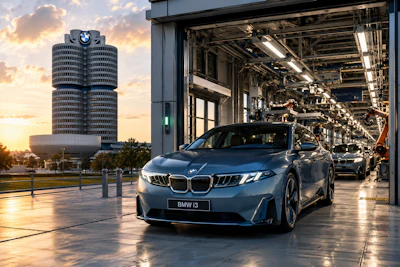
BMW workers are beginning series production of the new i3 electric sedan following a four-year overhaul of the German automaker's main Munich manufacturing facility.
The i3 is the second model based on BMW's Neue Klasse electric vehicle architecture. The vehicle uses an 800-volt electrical architecture, with preliminary Worldwide Harmonized Light Vehicles Test Procedure range reaching about 900 km depending on configuration. Charging rates reach 400 kW, with BMW officials saying drivers can add as much as 400 km of range in 10 minutes at a sufficiently powerful direct-current fast charger. Bidirectional charging is also supported.
“With the start of production of the BMW i3, we are lowering manufacturing costs by another 10%,” Munich plant director Peter Weber said. About one-third of the plant was rebuilt while vehicle production continued. High-voltage batteries come from Bavaria and electric motors from Steyr, Austria. Workers in Munich are expected to produce only fully electric vehicles beginning in 2027.
Production Peaq
Škoda workers are beginning series production of the new Peaq, a seven-seat electric sport utility vehicle, at the Czech automaker's main assembly plant in Mladá Boleslav.
Škoda is an automaker owned by Volkswagen Group. Workers are producing the Peaq on the same line as the electric Elroq and Enyaq and gasoline-powered Octavia, allowing plant managers to alter the mix of electric and internal-combustion vehicles as demand changes. Almost 8,500 Peaq orders had been placed by the end of July.
Workers at the Mladá Boleslav complex are also assembling the Peaq's high-voltage battery, the largest fitted to a Škoda vehicle to date. Production and logistics board member Andreas Dick said the arrangement demonstrates the “high flexibility and efficiency” of the automaker's manufacturing network.
Global Drive
Pony.ai executives are preparing to deploy thousands of robotaxis outside China as the autonomous driving technology developer expands into Europe, Asia and the Middle East.
Pony.ai develops autonomous driving systems and operates commercial driverless ride-hailing services. More than 4,000 robotaxis are covered by overseas deployment agreements, including more than 2,000 intended for European markets through a partnership with ride-hailing company Uber. Actual deployment remains subject to local regulatory approvals. Executives are separately targeting an operating fleet of 3,500 robotaxis by the end of 2026.
Chief executive James Peng said executives expect to exceed their full-year robotaxi service revenue target. Second-quarter robotaxi revenue increased 691.2% year over year and accounted for about one-third of total revenue. Executives are also planning to deploy between 500 and 1,000 autonomous heavy-duty trucks in China over the next two to three years.
Radar Road
Arbe Robotics engineers are beginning on-road trials of autonomous vehicles fitted with the automotive technology supplier's high-resolution radar systems.
Arbe Robotics is an Israeli supplier of radar chipsets and perception technology for advanced driver assistance and autonomous vehicles. Its systems are designed to provide information about the distance, direction, speed and elevation of surrounding objects. Previously announced robotaxi projects have now moved from development and vehicle integration to on-road trials.
“Our technology continues to gain traction across automotive, autonomous driving and defence applications,” chief executive Kobi Marenko said. Executives have not identified the robotaxi operators involved in the trials or disclosed where the vehicles are being tested.
Rebates Return
British Columbia officials are again offering incentives of as much as $130,000 toward eligible commercial zero-emission vehicles after reopening the province's medium- and heavy-duty vehicle rebate program.
The Go Electric Commercial Vehicle Pilots Program provides point-of-sale incentives for eligible battery-electric, plug-in hybrid and hydrogen fuel-cell vehicles. Incentives range from $5,000 for eligible Class 2B vehicles to $130,000 for Class 8 vehicles. Pickup trucks are excluded. Businesses can receive incentives for as many as five vehicles during a program year.
Indigenous organizations, local governments and non-profit organizations qualify for a 20% increase, bringing the maximum Class 8 incentive to $156,000. Those organizations can receive incentives for as many as 10 vehicles during a program year. The commercial vehicle incentive program had been paused in August 2025 before reopening on Aug. 10.