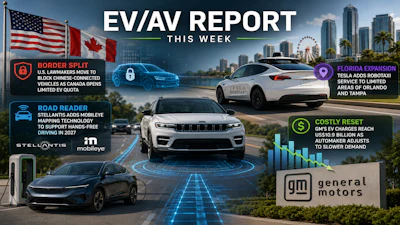
The EV/AV market faces significant shifts as Tesla expands its Robotaxi service to Florida cities, the U.S. moves to restrict Chinese-connected vehicles while Canada allows limited Chinese EV imports, Stellantis partners with Israeli tech firm Mobileye for autonomous features, and GM records $10.9 billion in charges from its EV restructuring.
- U.S.-Canada EV divide: The U.S. Senate proposes legislation to ban Chinese-connected vehicles, while Canada replaces its 100% tariff with a quota allowing 49,000 Chinese EVs annually at 6.1% tariff.
- Tesla Robotaxi expansion: Service now operates in limited areas of Orlando, Tampa, and Miami, using modified Model Y vehicles with varying levels of human supervision.
- Stellantis autonomous partnership: Selected Stellantis vehicles will integrate Mobileye's Road Experience Management technology in 2027 for lane-keeping and hands-free driving features.
- GM's EV restructuring costs: General Motors has recorded $10.9 billion in charges since 2025, including reduced battery production and conversion of EV capacity to gasoline vehicles.
- Mobileye data collection: Over 8 million vehicles supplied 34 billion miles of road data to Mobileye's platform in 2025 for autonomous driving development.
In this week's EV/AV report: The divide between Canada and the U.S. on Chinese EV imports grows; a European OEM turns to an Israeli technology provider; GM pays a steep price for backtracking on EVs; and Tesla's robotaxi fleet penetrates new markets.
U.S. lawmakers move to block Chinese-connected vehicles
U.S. lawmakers have moved to further restrict Chinese-connected vehicles as Canada prepares to admit a limited number of Chinese-made electric vehicles at a lower tariff.
The U.S. Senate Commerce Committee is considering bipartisan legislation that would place existing restrictions into law and broaden their reach. The bill would bar connected vehicles sold by manufacturers that are more than 15% owned by Chinese entities. It would also cover Bluetooth, Wi-Fi, cellular and some satellite communications technology.
“We’re preventing an absolute, total and complete destruction of our industrial base,” said Ohio Senator Bernie Moreno (a Republican), one of the bill’s sponsors.
“We’re not going to create dependency on China for battery management.”
The U.S. proposal contrasts with Canada’s decision to replace its 100% tariff with a quota allowing up to 49,000 Chinese-made EVs to enter each year at a 6.1% tariff.
Stellantis adds Mobileye mapping technology
Selected Stellantis vehicles will begin using road information gathered from millions of other vehicles to support lane keeping and hands-free driving in 2027.
The automaker, which owns the Chrysler, Dodge, Jeep and Ram brands, will add Mobileye’s Road Experience Management technology to selected U.S. models. The system uses front-facing cameras to collect information about lanes, curbs, crosswalks, road construction and common driving paths.
The Israeli autonomous-driving technology developer processes that information in the cloud and sends updated road data back to equipped vehicles. Mobileye said more than eight million vehicles supplied 34 billion miles of road data to the platform in 2025.
“We’re proud to expand our work with Stellantis,” said Nimrod Nehushtan, Mobileye executive vice-president of business development and strategy.
Drivers will still be required to watch the road while using the hands-free features.
GM’s EV charges reach US$10.9 billion
General Motors has recorded another US$2.3 billion in charges related to its electric vehicle restructuring.
The Detroit-based automaker has now recorded about US$10.9 billion in charges since beginning the reset in 2025. The changes include reducing battery production and converting some planned EV capacity to support gasoline-powered vehicles.
GM has continued introducing electric models while adjusting production plans to match slower-than-expected demand. The automaker also recorded its strongest quarter and first half for deliveries of vehicles equipped with Super Cruise, its hands-free driver assistance system.
“We continue to lower our warranty costs, reduce EV losses and increase operating efficiency,” chair and CEO Mary Barra said in a letter to shareholders.
Tesla enters two Robotaxi markets
Tesla has expanded its Robotaxi service to limited areas of Orlando and Tampa.
The Austin, Texas-based electric vehicle manufacturer announced the expansion through its official Robotaxi account on X. Maps released with the post show restricted service areas in both Florida cities.
“Robotaxi now in Tampa & Orlando!” the account posted.
Tesla did not disclose how many vehicles are operating or how many customers can access the service. The Florida expansion follows the launch of Robotaxi service in Miami earlier this month.
Tesla currently uses modified Model Y vehicles rather than its planned Cybercab. The level of human supervision varies by market, and some vehicles continue to operate with safety monitors or remote assistance.