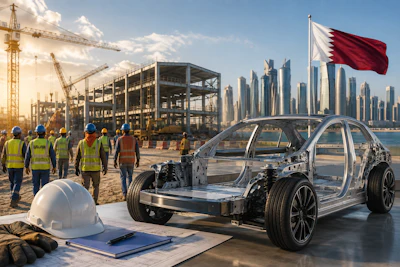
A new electric vehicle manufacturing operation planned for Qatar would combine British engineering with the local labour force to expand production of passenger and commercial EVs designed specifically for Gulf conditions.
JTA International Investment Holding CEO Dr. Amir Ali Salemi Zadeh and WATT Electric Vehicle Company CEO Neil Yates announced the project in Doha on Aug. 13. Engineers in the United Kingdom are expected to develop the vehicles before production moves to a new factory in Qatar.
Initial sales would target Qatar, followed by exports across the Gulf Cooperation Council and other international markets.
The vehicles will use WATT's PACES modular architecture. According to technical information published by WATT, the platform uses lightweight aluminium construction and is intended for low-to-medium-volume passenger and commercial vehicles.
The Qatar announcement does not disclose a production capacity, factory location, workforce size or construction timetable.
The project would add another major construction and manufacturing operation in a country whose treatment of migrant workers remains under international scrutiny.
Human Rights Watch researchers reported in their 2026 assessment of Qatar that illegal recruitment fees and passport confiscation remained common and that wage abuses persisted.
International Labour Organization officials have also documented substantial reforms. These include a non-discriminatory minimum wage, greater freedom to change employers and a Wage Protection System covering private-sector workers. ILO officials continue to identify gaps in timely wage payments and have documented retaliation against some workers seeking to change employers.
Nothing reviewed by Collision Repair links JTA, WATT or the proposed EV project to any labour abuses. The project remains at the planning stage, and no construction or manufacturing workforce has been publicly identified.
Collision Repair sent questions to a representative for the project on Aug. 13 seeking details of the safeguards that would apply once hiring begins. The questions covered the use of migrant labour, recruitment fees, passport retention, changes to employment terms, wage protection, contractor and subcontractor oversight, accommodation, medical care, heat protection, grievance procedures and worker representation. No response had been received by publication.
Labour and human-rights concerns surrounding EV production are not confined to Qatar. U.S. Department of Labor researchers have documented child labour in artisanal cobalt mining in the Democratic Republic of Congo and traced that cobalt into the wider lithium-ion battery supply chain, including batteries used in electric vehicles. Because cobalt from different mines can be mixed during processing, officials warn that material produced with child labour can become difficult to distinguish further down the supply chain.
Amnesty International researchers assessed the human-rights due-diligence reporting of 13 major EV manufacturers in 2024. They concluded that most were not demonstrating sufficiently that they met international human-rights standards across mineral supply chains involving materials including cobalt, copper, lithium and nickel.