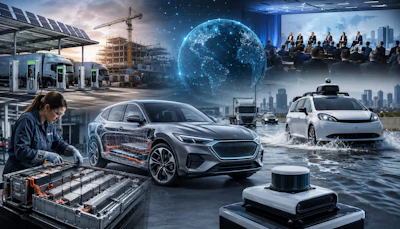
In this week’s EV/AV report, electrification increases repair complexity, Canada’s EV supply chain gets a reality check, autonomous vehicles run into floodwater and fleet charging starts moving from access to reservations.
Safety Summit
Regulators from across North America arrived in Toronto for the 28th International Technical Conference on the Enhanced Safety of Vehicles at Exhibition Place in Toronto.
The event, which ran from May 12 to 15, was hosted by Transport Canada, the federal department responsible for transportation policy and regulation and the National Highway Traffic Safety Administration. It included sessions on automated driving systems, AI-enabled safety technology, cybersecurity, crash avoidance, vehicle design and next-generation safety standards.
Steven MacKinnon, Canada’s minister of transport and leader of the government in the House of Commons, said, “Canada is proud to welcome the global road safety community to Toronto for Enhanced Safety of Vehicles 2026.”
Honda's Halt
One of Canada’s biggest promised EV investments is no longer moving forward as planned. The pause is a major signal about how quickly the North American EV manufacturing picture has changed.
Honda Canada Inc., the Markham, Ont.-based Canadian division of Japanese automaker Honda Motor Co., Ltd., indefinitely suspended its planned $15-billion EV value chain investment in Ontario, including EV and battery-related work tied to Alliston. The company indicated the decision does not affect current production or employment levels at its existing Ontario manufacturing facility. Honda Canada attributed the move to evolving business conditions, changes in external resource strategy and shifting customer demand.
Waymo Floods
A pioneering AV company is recalling close to 4,000 AVs to address an issue related to flood events.
Waymo LLC, the Mountain View, Calif.-based autonomous driving subsidiary of Alphabet Inc., filed a voluntary recall covering 3,791 fifth- and sixth-generation automated driving systems after a software issue could allow vehicles to slow and then drive into standing water on higher-speed roadways.
The recall followed an April 20 incident involving an unoccupied Waymo vehicle and floodwater. Waymo also paused or limited service in several markets during severe weather and suspended freeway operations while working through construction-zone and flood-related issues.
EV Surge
The global EV market is growing, but that growth is uneven.
The International Energy Agency, the Paris-based intergovernmental energy policy organization, released its Global EV Outlook 2026 in May, forecasting 23 million electric car sales this year. That would put EVs close to 30% of all cars sold worldwide. The IEA also reported more than 20 million EV sales in 2025, with record sales in close to 100 countries.
Fatih Birol, executive director of the International Energy Agency, said, “Electric car sales set new records in close to 100 countries last year.”
Fleet Reservations
Two Canadian companies are developing an open, interoperable charging reservation platform for electric trucks.
ChargeHub, a Montreal-based EV roaming and charging platform operated by Mogile Technologies Inc., and AXSO inc., a Quebec-based Hydro-Québec subsidiary that develops software for EV charging operations.
The project is backed by $450,000 from the Government of Quebec and is designed to let fleet operators reserve charging slots across participating networks. Circuit électrique, Hydro-Québec’s public charging network, Nationex and Intelcom are among the partners involved in the project.
Francis De Broux, chief operating officer of ChargeHub, said fleet downtime at a charging station can cascade through an entire day’s logistics.
Battery Repair
Unless an economical solution to EV battery repairs is discovered, more damaged EVs will be written off, a new report hs found.
Cox Automotive Europe, the U.K.-based European division of Atlanta-based automotive services company Cox Automotive, and other specialists are warning that EV battery design has too often prioritized range, charging speed and recycling over serviceability. That creates a repair and resale problem as older EVs enter the used market. For insurers and bodyshops, the issue is whether battery damage can be assessed and repaired safely without defaulting to full-pack replacement.
Antonia Stephenson, director of operations for EV Battery Solutions Europe at Cox Automotive, said, “If you’re manufacturing EVs that can’t be repaired, it’s going to be a real challenge to sustain residual values.”