In this week's EV/AV report: a supervised autonomous travel is trialled, consumer EV education in Québec gets an upgrade and construction progresses at an ambitious Ontario battery plant.
Border Testing
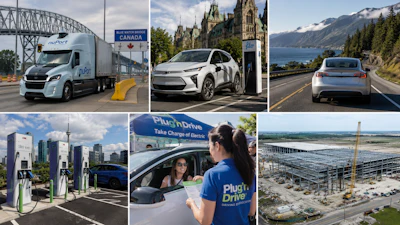
A year-long autonomous freight trial has demonstrated how a modified transport truck handled congestion, narrow lanes and controlled-access areas near the Blue Water Bridge in Sarnia, Ont.
Engineers at Markham, Ont.-based NuPort Robotics conducted the project from February 2025 through January 2026 with support from the Ontario Vehicle Innovation Network and the Federal Bridge Corporation, which operates the Canadian side of the crossing. The truck did not enter the United States.
Testing included site surveys, data collection, manual driving and supervised autonomous operation. A separate platooning demonstration used a human-driven U-Haul truck as the lead vehicle. A retrofitted Class 8 truck followed under automated control, with a safety driver seated inside and ready to intervene. Platooning allows a following vehicle to coordinate its speed and spacing with a lead truck; it was not a driverless commercial freight service.
The work was intended to support possible future freight operations between Sarnia and Detroit, although any cross-border deployment would require additional testing and regulatory approval in both countries.
"Projects like this are important because they help us better understand how emerging freight technologies may interact with critical border infrastructure in a real operating environment," Federal Bridge Corporation CEO Joe DeDecker said.
No figures were released for kilometres driven, system disengagements or safety interventions.
Registration Gains
S&P Global Mobility registration data have placed Chevrolet, Cadillac and GMC models at more than 20% of Canadian battery-electric vehicle registrations during the first six months of 2026.
Battery-electric registrations across the three brands increased 33.4% compared with the first half of 2025, according to figures cited in a July 28 release issued by General Motors Canada.
The Chevrolet Equinox EV, Chevrolet Bolt and Cadillac OPTIQ ranked among Canada's 10 most-registered battery-electric vehicles through June. Equinox EV registrations increased 12% year over year. Cadillac battery-electric registrations increased 63.9%, while the brand accounted for 52.6% of Canada's luxury battery-electric segment.
"More than 65% of our EV buyers this year are new to Chevrolet, GMC or Cadillac," said Shane Peever, vice-president of vehicle sales, service and marketing at General Motors Canada.
Cross-Country Demonstration
Three Canadian Tesla owners have completed a leisurely drive from Vancouver to Halifax using Tesla's Full Self-Driving software without reporting a driver intervention.
Tesla owner Devin Olsen of Langley, B.C., joined U.S.-based FSD tester David Moss and a third participant in completing the 6,051-km drive without driver intervention.
The journey was completed using FSD version 14.3.3 and took approximately one week. The route crossed British Columbia, the Prairies, Northern Ontario, Québec and Atlantic Canada. Although the software performed the driving tasks, a licensed driver remained behind the wheel throughout the trip and was responsible for supervising the vehicle, as required under Canadian law.
The demonstration was privately organized and was not conducted or independently verified by Tesla. It does not constitute regulatory approval of autonomous driving technology or indicate that the system is approved for driverless operation in Canada.
Participants said the route included urban traffic, divided highways, construction zones and mountain roads. The drive is among the longest publicly documented supervised Full Self-Driving demonstrations completed entirely within Canada.
Public Outreach
Plug'n Drive has expanded its electric vehicle education program in Québec with additional public events in Québec City.
The non-profit organization operates travelling exhibitions that allow prospective buyers to explore battery-electric vehicles, learn about home and public charging, compare ownership costs and participate in supervised test drives without visiting dealerships.
The Québec events are intended to answer common questions about charging, winter driving, battery life and operating costs as governments and industry continue encouraging EV adoption. Plug'n Drive has operated similar education programs in Ontario for several years and said the expansion is intended to reach consumers who remain unfamiliar with battery-electric vehicles.
Factory Construction
Construction has advanced from foundation work to structural steel installation at Volkswagen subsidiary PowerCo's battery-cell plant in St. Thomas, Ont.
The approximately $7-billion project, announced in 2023, is scheduled to begin production in 2027. At full capacity, the facility is expected to produce up to 90 gigawatt-hours of battery cells annually, enough for approximately one million electric vehicles.
Crews are erecting steel columns, beams and roof trusses for the production buildings. The completed complex is expected to cover approximately 1.5 million square feet and employ up to 3,000 people.
Federal and provincial production incentives could total as much as $13 billion. Those incentives are tied to batteries produced and sold in Canada rather than the cost of constructing the facility.