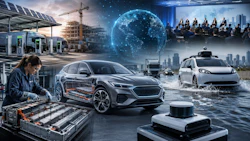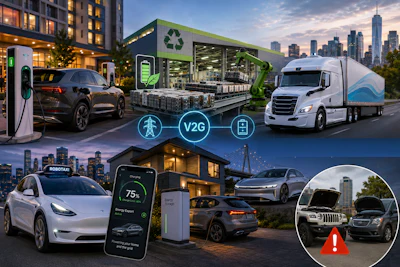
In this week’s EV/AV report, a B.C. battery recycler moves closer to opening a second-life production site, while U.S. automakers and technology firms push further into grid storage, autonomous freight, robotaxis and electrified-system recalls.
Moment Energy prepares second-life EV battery plant in B.C.
A B.C. battery repurposing company is preparing to open a second-life EV battery facility in Surrey.
Moment Energy, a Coquitlam, B.C.-based EV battery repurposing company, was reported June 3 to be preparing to open a new facility in Surrey, B.C., by the end of June.
The site is expected to support up to one GWh of annual energy-storage production by 2030. The company also expects the project to create more than 100 jobs in British Columbia over five years.
Edward Chiang, co-founder and chief executive officer of Moment Energy, said the project uses “existing battery resources to deliver the reliable, affordable power that is so crucial right now.”
PepsiCo and Gatik sign autonomous freight agreement
A U.S. food and beverage company is expanding autonomous freight work with a California self-driving technology firm.
PepsiCo, a Purchase, N.Y.-based food and beverage company, and Gatik, a Mountain View, Calif.-based autonomous freight technology company, announced a multi-year autonomous freight agreement in North America on June 8.
The agreement covers autonomous middle-mile freight work, with Gatik already moving goods for PepsiCo in Texas, Arizona and Arkansas. It is the largest commercial autonomous freight deployment to date.
Jim Farrell, senior vice-president of supply chain at PepsiCo, said Gatik brings “the autonomous freight technology, commercial experience, and scale we need.”
GM moves EVs into the grid business
A Detroit automaker is expanding its EV energy business with grid-balancing, battery storage and app-based charging tools.
General Motors announced June 9 that it is expanding its work in vehicle-to-grid technology, sodium-ion battery storage and app-based charging tools through GM Energy.
The announcement said more than a quarter-million bidirectional-capable GM EVs are now on U.S. roads. GM is also testing grid-balancing programs with PG&E in Northern California and DTE Energy in Michigan.
Sterling Anderson, chief product officer at General Motors, said: “By injecting flexibility into a historically rigid system, V2G technology simultaneously can lower aggregate energy costs.”
Tesla expands unsupervised robotaxis in Austin
A Texas-based EV manufacturer is expanding unsupervised robotaxi service across the Austin metro area.
Tesla, the Austin, Texas-based EV manufacturer, expanded its unsupervised robotaxi service across the Austin metro area on June 3.
The service had been operating in Austin for nearly a year before the wider rollout. Tesla had about 50 vehicles in the city, while Waymo had more than 250 vehicles operating in the same market.
The expansion pushes Tesla’s robotaxi program further into public service, though its local fleet remains smaller than Waymo’s.
Uber’s Nuro commitment nears US$500 million
A U.S. ride-hailing company is putting nearly US$500 million behind a robotaxi plan with Nuro and Lucid.
Uber, the San Francisco-based ride-hailing company, has committed nearly US$500 million to Nuro, a Mountain View, Calif.-based autonomous driving company.
The investment is tied to a larger plan involving Nuro and Lucid Motors to deploy 35,000 robotaxis using Lucid vehicles, Nuro’s autonomous technology and Uber’s platform.
Nuro had previously shifted away from delivery robots and toward licensing self-driving software.
Jeep and Chrysler fire-risk recalls hit electrified systems
A Dutch automaker is issuing recalls tied to fire risks in more than one million Jeep and Chrysler vehicles.
Stellantis, the Netherlands-based automaker with major North American operations, issued recalls reported June 9 affecting more than one million Jeep Wrangler and Gladiator vehicles because of a fire risk tied to electric hydraulic power steering pump wiring.
The Jeep recall covers 1,076,699 vehicles from the 2021 through 2025 model years. A separate Chrysler Pacifica plug-in hybrid recall affects 17,277 minivans because the battery may catch fire even when the vehicle is off. Owners were told to park affected vehicles outside and away from buildings or other vehicles until repairs are available.