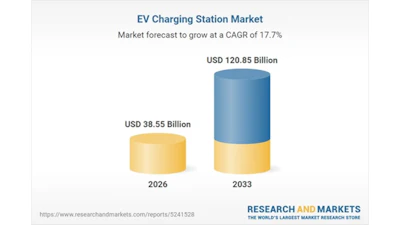

The global EV charging station market is projected to reach $120.85 billion by 2033, growing at a compound annual growth rate of 17.7%, driven by vehicle platform evolution, charging ecosystem integration, grid modernization, and strategic partnerships between automakers, charge point operators, and energy providers.
- Market Size: EV charging station market expected to reach $120.85 billion by 2033 with a 17.7% compound annual growth rate
- DC Fast Charging Dominance: DC infrastructure accounts for approximately 46% of market share in 2026 and positioned to capture largest share of deployments through 2033
- Technology Drivers: BYD's Super e Platform with megawatt-class charging, 800V/1,000V architectures, and bidirectional charging technologies improving utilization and grid interaction
- Regional Growth: Asia Pacific (excluding China) expected to capture significant market share, with India leading Asia Pacific EV charging market
- Key Players: ABB, BYD, ChargePoint, Tesla, and Siemens dominating the competitive landscape
A new report from global market research store and aggregator Research And Markets states that the EV charging station market is projected to reach US$120.85 billionby 2033, driven by the convergence of vehicle platform evolution, charging ecosystem integration and utility grid modernization.
While those wanting to read the entire 494-page report will have to pay for access, “EV Charging Station Market by DC Fast Charging, Application, Level of Charging, Charging Point, Charging Infrastructure, Operation, Charge Point Operator, Connection Phase, Service, Installation, and Region - Global Forecast to 2033,” has been summarized by the company.
With a compound annual growth rate of 17.7%, the global EV charging station market is expanding through end-to-end charging ecosystems established by OEMs through strategic partnerships with charge point operators, energy providers and technology companies.
According to the report, sustaining long-term growth is dependent on the industry’s ability to “scale high-power charging infrastructure, secure grid connectivity and develop interoperable charging networks that can support the next phase of passenger and commercial vehicle electrification.”
Research and Markets officials noted in the report summary that BYD’s introduction of its Super e Platform with megawatt-class charging capability in March 2025, OEMs’ accelerating the rollout of 800V and 1,000V architectures and advancements in bidirectional charging technologies, energy management software and power semiconductors are improving charger utilization and grid interaction capabilities.
Fixed charging stations are expected to be the largest segment of the market during the forecast period by installation type, driven by their “extensive deployment across public charging hubs, highway corridors, commercial properties and fleet charging depots,” stated the report summary.
By the end of 2025, the public charging infrastructure experienced a shift, wherein charging availability became a network optimization challenge, rather than a deployment one. In 2026, the global DC fast chargers market accounts for approximately 46% of the total market share, and DC infrastructure is positioned to capture the largest share of incremental station deployments globally through 2033, stated the report summary.
Asia Pacific, with the exception of China, is expected to account for a significant market share during the forecast period, with India predicted to account for the largest share of the Asia Pacific EV charging station market. Major players dominating the EV charging station market include ABB (Switzerland), BYD (China), ChargePoint (US), Tesla (US) and Siemens (Germany).
Market dynamics indicate that driving factors include financial incentives by government to promote charging networks, ongoing fleet electrification and strategic partnerships between OEMs to secure charging access. In addition, market challenges include fragmented charging standards globally, high capital investment for ultrafast charging infrastructure and regulatory hurdles in EV charger installation, among others.
To learn more, click here.