
Canada's public DC fast-charging network is being used only 9.5% of the time in Q2 2026, falling significantly below the 20% utilization threshold needed for long-term profitability, despite the network expanding 30% year-over-year with 390 new ports added.
- DCFC utilization in Canada dropped to 9.5% in Q2 2026, down from 11.3% in Q1 2026 and 10.3% year-over-year
- Canada added 390 new DCFC ports across 99 stations in Q2, representing a 30% year-over-year increase
- Healthy profitability requires 20% utilization, meaning Canada's network operates at less than half the necessary threshold
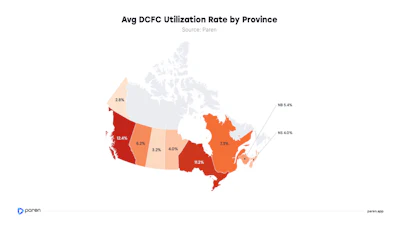
- Regional performance varies significantly: British Columbia (12.4%), Ontario (11.2%), and Québec (7.3%) lead, while Manitoba, Nova Scotia, and Yukon lag below 5%
- Vancouver and Toronto exceed profitability benchmarks at 22.6% and 17.3% utilization respectively, despite overall national decline
EV fast chargers are only being used 9.5% of the time in Canada in the second quarter of 2026, according to a new study from charging analytics firm Paren.
As Canada’s public direct current (DC) fast-charging network grows faster than EV demand, charging ports are being used less frequently, falling below the healthy 20% utilization threshold for long-term profitability.
Ports were used 11.3% of the time in the first quarter of 2026 and 10.3% of the time in the same period last year. Canada brought 390 new DCFC ports online across 99 new stations in Q2, the study reported, a 30% year-on-year step up and significant increase from the entire Q2 2025 total of 300 ports and 81 stations.
However, port use varied across the country. British Columbia recorded the highest use at 12.4%, followed by Ontario at 11.2% and Québec at 7.3%. All three provinces reported less use than the previous quarter.
Yet, B.C., Ontario and Québec contained nearly all of Q2’s new ports and were the only provinces where use fell, compared to the provinces with little new build that held flat or rose, such as Alberta, New Brunswick and Saskatchewan.
According to the study, low-density provinces — Manitoba (4.0%), Nova Scotia (4.0%), Saskatchewan (3.2%) and Yukon (2.8%) — remained at the bottom.
Demand remains high in Vancouver and Toronto, with both cities reporting utilization above the profitability benchmark at 22.6% and 17.3%, respectively. While most metros decreased quarter-over-quarter, Paren stated that the decline is not due to oversupply, but rather a winter-to-spring seasonal fade.
National reliability increased from 90.3 in Q1 to 91.2 in Q2. At a fixed 20% utilization / 90 reliability frame, none of the Canadian provinces are “stressed.” Reliability, not use, is the dividing line. Nationally, Canada sits at 9.5% utilization and 91.2 reliability.
Read the State of the EV Charging Industry Q2 2026 Canada report here.