A Surrey plant is producing commercial power storage units from used electric vehicle batteries while a Montreal battery repurposer suspends operations, highlighting both growth and challenges in Canada's EV battery recycling industry. Meanwhile, repeat battery recalls are increasing and autonomous vehicles face new safety scrutiny ahead of Toronto testing.
- Moment Energy's Nova power storage system launched in Surrey, B.C., with units storing 500 kilowatt-hours and delivering up to 200 kilowatts of power for commercial backup and peak demand use.
- Montreal-based EVB360 suspended operations citing difficult market conditions and insufficient supply of end-of-life EV batteries for repurposing.
- At least 15 Canadian high-voltage battery recalls since October 2023 required repeat repairs or buybacks due to earlier fixes failing or being done incorrectly.
- Waymo faces two U.S. recalls detailing how its autonomous vehicles mishandled closed freeway lanes and police traffic direction before Ontario approved Toronto testing.
- Canadian plug-in vehicle sales rose 66.6% in September 2026, accounting for 15.8% of new-vehicle sales, with Quebec leading at 11,132 units sold.
In this week’s AV/EV Report, a Surrey plant is building commercial power storage units out of used electric vehicle batteries as a Montreal battery repurposer suspends operations.
Also this week, Canadian drivers face repeat battery recalls, two U.S. recalls detail how driverless cars handled road closures and police directions, a new EV earns four stars in European crash tests and Canadian plug-in sales rise 66.6%.
Surrey plant builds power storage units from used EV batteries
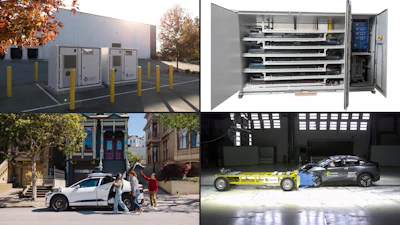
Production of Moment Energy’s Nova power storage system is underway in Surrey, B.C., with first deliveries planned for early 2027. Each unit stores 500 kilowatt-hours and delivers up to 200 kilowatts of power. Commercial customers can use the units for backup power or draw on them when electricity demand peaks.
Moment Energy’s published intake criteria call for intact lithium-ion packs with roughly 70% state of health or higher and their original battery management systems and connectors. Damaged, defective and recalled packs are excluded. The criteria leave open whether an intact pack from a collision writeoff qualifies.
Staff review pack details and quote a price before arranging transport. The pack is tested on arrival. Moment Energy has no published price schedule and does not specify who pays freight. The company has previously announced supply relationships with Nissan North America and Mercedes-Benz Energy. Its Nov. 17 launch announcement did not identify Nova’s suppliers.
Moment Energy and Toronto-based diagnostics developer Pulsenics announced a $5-million battery testing project in April. The system they plan to use can report a pack’s state of health in less than 30 minutes, according to the announcement.
“The ability to rapidly and accurately qualify used batteries is critical in scaling the repurposed battery industry,” said Edward Chiang, co-founder and chief executive officer of Moment Energy.
Montreal battery repurposer suspends operations
Montreal-based EVB360 has suspended its electric vehicle battery repurposing operations, citing difficult market conditions. Martin Ménard, director of project development, disclosed the decision to CBC News, which reported it Nov. 24. He gave no date for a restart.
EVB360 developed a 20-kilowatt-hour storage unit using refurbished batteries from long-range Tesla Model 3 and Model Y vehicles. Ménard said testing and certification required substantial investment and that used packs were in short supply.
“There simply aren’t enough end-of-life EV batteries available today,” Ménard told CBC.
Freight and pack assessment were major costs in a study of battery recovery options on Vancouver Island. Ziyu Wang, a doctoral researcher at Concordia University, told CBC that conventional recycling cost about $750 per pack in the study. A process that recovered lithium cost roughly $1,500. The study found repurposing packs on the island was the most feasible option it examined.
EVB360 has published no purchase prices or intake criteria for packs from collision writeoffs. Transport Canada prohibits shipping damaged or defective lithium batteries that could catch fire or react dangerously under normal transport conditions.
Battery recalls send Canadian vehicles back for repeat repairs
At least 15 Canadian high-voltage recall notices issued since October 2023 called for another repair or a buyback because an earlier fix may have failed or been done incorrectly, a review of Transport Canada records through Oct. 22 found.
A February recall covers 22,955 Ford Escape and Lincoln Corsair plug-in hybrids. A battery short circuit can cut power to the wheels or cause a fire, including while the vehicle is parked. The recall calls for a software update to monitor the battery. If a warning appears, owners are to arrange a battery replacement through a dealer.
An October 2025 recall covers 20,753 Jeep Wrangler and Grand Cherokee 4xe plug-in hybrids after an earlier battery fix may have failed. A March 2024 recall covering 86 Jaguar I-Paces called for a third repair on some cars. A separate November 2025 notice called for Jaguar to buy back one I-Pace.
Transport Canada’s monthly database lists 29 high-voltage recall notices through Oct. 22 this year, up from 25 over the same period in 2025. A vehicle can appear in more than one campaign, so a completed recall on a vehicle’s service record can be followed by another notice for the same battery fault.
Two U.S. recalls detail Waymo faults ahead of Toronto tests
Ontario has cleared Waymo to begin testing in Toronto with human drivers. The company is aiming to offer paid driverless rides in 2028, subject to further approvals. Two U.S. recalls detail problems with how its vehicles handle closed freeway lanes and police directing traffic.
One recall covers 4,488 automated driving systems. Waymo reported 11 instances of vehicles entering closed freeway lanes beginning Oct. 1, including three that drove into lanes closed by construction cones on Nov. 9. Officials restricted freeway operations while they develop a permanent software fix.
The second recall followed a May 8 crash. A Waymo vehicle stopped when a police officer signalled it to do so. After cross-traffic blocked its view of the officer, it moved and struck another vehicle. Waymo completed a software update for that problem Nov. 6.
Ontario requires applicants for driverless testing to explain how their vehicles will handle work zones and interact with first responders. A Liaison Strategies poll of 1,000 Toronto residents on Nov. 14 and 15 found 64% supported testing with a driver. For paid driverless rides, 51% were opposed and 36% were in favour.
“Safety concerns go beyond the person booking the ride,” said David Valentin, principal at Liaison Strategies. In the poll, 45% expected driverless cars to make streets more dangerous for pedestrians and cyclists, compared with 19% who expected them to make streets safer.
Plug-ins account for nearly one in six new vehicles sold in Canada
Canadians bought 28,490 new battery-electric vehicles and plug-in hybrids in September, up 66.6% from a year earlier. Plug-ins accounted for 15.8% of new-vehicle sales, up from 10.1%. Overall new-vehicle sales rose 7% to 180,457, according to Statistics Canada.
Buyers purchased 5,774 more plug-ins than in August, a 25.4% increase in unadjusted sales. In September, plug-ins accounted for 27.8% of new sales in B.C. and the territories, which Statistics Canada reports together, and 25.3% in Quebec. Ontario reached 12.5%, followed by Alberta at 7.2% and Saskatchewan at 3.7%.
Quebec led the country by volume with 11,132 plug-in sales. Ontario recorded 8,933, up from 5,064 a year earlier.
The federal Electric Vehicle Affordability Program offers up to $5,000 for eligible battery-electric vehicles and up to $2,500 for eligible plug-in hybrids in 2026. The $50,000 transaction price cap does not apply to vehicles made in Canada.