In this week’s EV/AV report, Canada’s electric vehicle landscape continues to evolve, with new data showing growth in charging infrastructure and a sharp rebound in zero-emission vehicle sales following the return of federal incentives. At the same time, Ottawa is deepening its investment in the battery supply chain, while regulators in the United States move to expand autonomous vehicle rules into heavy-duty trucking.
Canada building fast-charging ports
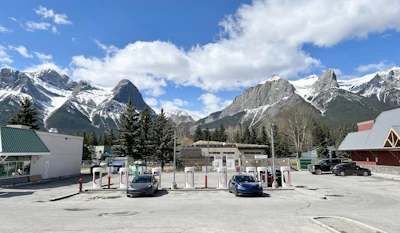
Canada added 668 new DC fast-charging ports in the first quarter of 2026, bringing the national total to 9,472, according to data reported by Drive Tesla Canada. The figures are based on national tracking of public charging infrastructure across federal, provincial and private networks.
The report indicates that while the number of new charging locations has slowed, the size of individual stations is increasing, with more charging ports being installed per site. This reflects a shift in deployment strategy toward higher-capacity charging hubs.
ZEV sales rise 47% after rebate returns
Canadian zero-emission vehicle sales increased 47% following the reintroduction of federal purchase incentives, according to figures from Transport Canada. T
he program provides up to $5,000 for battery-electric and fuel-cell vehicles and up to $2,500 for plug-in hybrids.
The same dataset shows that 124,004 total vehicles were sold in February 2026, representing a 0.9% year-over-year decline in overall vehicle sales. The increase in ZEV sales occurred after the federal incentive program resumed earlier in the year.
Ottawa backing Mangrove Lithium battery project
The Government of Canada announced its support for Mangrove Lithium’s facility in Delta, B.C., on April 16, according to a release from Natural Resources Canada.
The project is expected to produce enough battery-grade lithium to supply approximately 25,000 electric vehicles annually. The same release states that 87% of global lithium demand is associated with batteries, electric vehicles and energy storage.
Natural Resources Minister Jonathan Wilkinson said the investment is intended to support the development of a domestic battery supply chain.
The BMW-backed facility processes spodumene concentrate into battery-grade lithium hydroxide used in electric vehicle batteries.
The government's move is part of broader efforts to expand battery material processing capacity in North America.
California approves heavy-duty autonomous vehicle rules
California approved new regulations on April 29 allowing the testing and deployment of heavy-duty autonomous vehicles on public roads. The rules expand existing autonomous vehicle frameworks beyond passenger vehicles.
The regulations apply to commercial trucks and other large vehicles. Regulators indicated the rules are intended to support development of autonomous technology while maintaining safety oversight.
Prior to the approval, Steve Gordon, director of the California Department of Motor Vehicles, said the agency’s approach is designed to “enhance public safety while facilitating innovation on California roadways."