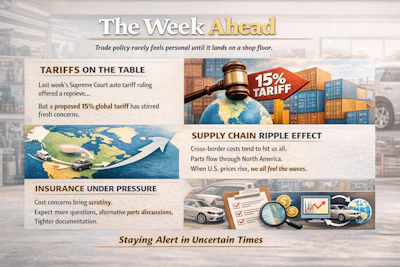

Last week’s U.S. Supreme Court decision striking down broad auto tariffs might have suggested a cooling of cross-border tension. Within days, however, a new proposed 15 per cent global tariff shifted the conversation again.
Whether one views it as strategic positioning or political reaction, the message for our industry is the same: volatility in trade policy has not disappeared. For Canadian collision repairers, the impact will not be immediate, but it will not be theoretical either.
The North American automotive supply chain is tightly integrated. Parts cross borders multiple times before reaching distributors and ultimately repair facilities. Even if Canada does not mirror a U.S. tariff action, pricing structures are often influenced by U.S. benchmarks. When costs rise south of the border, the ripple rarely stops there.
The practical question for shops is not whether list prices will move tomorrow. It is how suppliers respond over the coming months. Distributors may adjust sourcing. OEMs may recalibrate pricing strategies. Lead times can shift when companies reassess inventory positions amid uncertainty. We have seen before that complexity increases long before clarity arrives.
An equally important layer is how insurers respond. At this stage, there have been no public indications that major carriers have revised parts reimbursement guides in direct response to these developments. Historically, insurers rely on estimating platform feeds and OEM pricing updates rather than issuing standalone declarations. If tariff-driven cost increases materialize, they are more likely to flow gradually through those systems than appear in an abrupt bulletin.
In the near term, repairers may notice something subtler. When cost pressure enters the system, scrutiny tends to follow. Adjusters ask more questions. Alternative parts discussions become more frequent. Documentation expectations rise. That friction often precedes any formal recalibration of pricing assumptions.
None of this calls for alarm. It does call for attention. Trade headlines move quickly, but cost structures shift in increments. Shops that maintain disciplined documentation, communicate clearly with customers and insurers, and monitor supplier signals closely are best positioned to manage the uncertainty.
This week, the real story is not the legal argument in Washington. It is how suppliers, OEMs and insurers interpret what comes next. We will be watching pricing feeds, distributor messaging and carrier tone carefully. Because in this industry, global decisions eventually find their way into local estimates.
I look forward to hearing your comments. You can share your thoughts in the comment box below or reach out to me directly.
Darryl