Create a free EV Repair account to continue reading
ARE YOU READY FOR THE EV IN BAY ONE?
April 22, 2026
COLLISION CLAIMS FOR ELECTRIC VEHICLES IN CANADA JUMPED 24 PERCENT IN 2025 — EVEN AS SALES SLOWED. THE SHOPS THAT AREN’T PREPARED ARE ALREADY LOSING WORK. HERE’S WHAT THE DATA SAYS, AND WHAT YOU NEED TO DO ABOUT IT
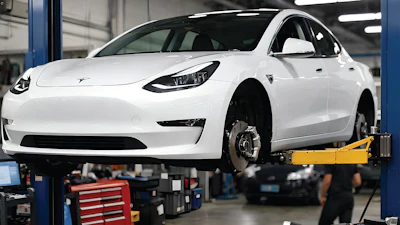
The car sat in the bay for weeks. From the outside it looked like a straightforward job — a headlight, a bumper, a northern Ontario Tesla that had caught the wrong side of a collision. But the technicians didn’t have the parts, and they didn’t have the know-how. The car went to Tesla directly. The final bill: $18,000. The shop got nothing.
That story is becoming less unusual. And if it hasn’t happened in your shop yet, the numbers suggest it’s only a matter of time.
WHAT DO THE NUMBERS ACTUALLY SAY ABOUT EV REPAIR DEMAND?
Canada’s EV market has had its share of turbulence. Sales retreated in early 2025 after federal and provincial purchase incentive programs were suspended, and trade uncertainty added to the headwinds. But slower sales do not mean fewer EVs on the road.
According to Mitchell’s 2025 Plugged-In: EV Collision Insights report, repairable battery electric vehicle (BEV) claims in Canada represented 4.77 percent of all repairable auto claims — a year-over-year increase of 24 per cent. Add mild hybrid electric vehicles (MHEVs) at 4.44 percent (up 29 percent) and plug-in hybrids (PHEVs) at 1.55 per cent (up 26 percent), and the electrified share of the Canadian collision workload is already approaching 11 percent.
British Columbia leads all of North America at 8.48 percent repairable BEV claims frequency. Quebec sits at 8.21 per cent — both ahead of California’s 6.58 per cent. In those markets, EV repair is not a specialty. It is part of the regular workload.
Claims severity is narrowing, too. Average repair cost for a repairable BEV in Canada fell two per cent in 2025 to $7,253. Insurers are pushing harder for repair over replacement — putting pressure on shops to be capable, not simply willing, to take the work.
OEM parts account for 86 per cent of parts dollars on repairable BEV estimates, versus 62 percent for ICE vehicles. That gap makes OEM certification and relationships more necessary than ever.
WHY IS EV TRAINING NON-NEGOTIABLE?
EV electrical systems carry voltages that can kill. That is not hyperbole — it is the central fact that makes technician training the most non-negotiable investment a shop can make. Most automakers now require documented proof of technician competency before granting certification — a direct condition of access to parts, procedures and insurer-directed work.
I-CAR Canada, operated by AIA Canada, has developed a structured curriculum for EV collision repair covering high-voltage safety, cooling systems, repair procedures and specialized diagnostics including HV isolation testing and milliohm meter use. In June 2024, I-CAR Canada partnered with Quebec’s CPCPA to provide immediate EV training access, with completed courses counting toward I-CAR Gold Class status.
In September 2025, AIA Canada released minimum national standards for collision repair. They carry no legal force but give insurers and consumers a clear benchmark for what a properly equipped shop should look like.
DOES THE SHOP HAVE THE RIGHT TOOLS TO MAKE THE REPAIRS?
Trained staff are only part of the equation. EV repairs require specific equipment that either exists in the shop or doesn’t: insulated hand tools, battery lifting equipment, manufacturer-approved scan tools, ADAS calibration equipment. Without them, certain repairs cannot proceed safely.
In 2025, BEVs averaged 1.70 ADAS calibrations per repair estimate versus 1.54 for ICE vehicles. A shop not set up for calibration is misaligned with an increasing share of every EV job that comes through the door.
HOW REAL IS THE FIRE RISK WITH DAMAGED EVS?
Physical facility upgrades are the most expensive part of EV readiness — and the most consequential if ignored. A hard impact can trigger thermal runaway: a self-sustaining chemical reaction that generates its own heat and is extremely difficult to suppress. EV battery fires burn at significantly higher temperatures than gasoline fires and require vastly greater volumes of water.
According to research by EV FireSafe, reignition occurred in approximately 10 per cent of EV fire incidents studied globally — in one documented case, 68 days after the initial incident. The NTSB has identified thermal runaway as a significant safety concern for second responders, a category that explicitly includes collision shops.
Best practice: keep damaged EVs isolated outdoors, terminals protected, with sufficient spacing between units. Protocols must exist before an incident, not after. Staff must know the warning signs — unusual heat, swelling, off-gases, popping or hissing — and know exactly what to do.
WHAT IS FORMING A TWO TIER MARKET?
The readiness gap is creating a two-tier market. Shops that have invested in training, tooling and infrastructure are positioned to capture EV work as volume grows. Shops that have not are increasingly at risk of losing it — often to dealerships or manufacturer-owned service networks.
OEM certification networks are tightening requirements and tying access to parts, technical data and insurer-preferred status to demonstrated competency. Insurers are already steering EV claims toward facilities they trust. With BEV claims severity averaging $7,253 in Canada in 2025, a shop completing five additional BEV repairs per month is looking at roughly $435,000 in annual gross revenue — revenue that either flows to a certified facility or does not.
HOW MUCH TIME DO SHOPS HAVE TO ADAPT?
The state of EV readiness in Canada’s collision repair sector is best described as uneven and transitional. Shops most exposed to EV volume have largely adapted out of necessity. Shops in slower-adoption markets have more time — but the window is narrower than it appears.
The fleet of EVs already on Canadian roads is not going away. The infrastructure of OEM certification and insurer steering is quietly rewarding prepared facilities and penalizing unprepared ones. The shops that map their gaps and build a realistic plan will be the ones positioned to compete. Those that put it off will find the catch-up far more costly than the preparation would have been.