
Don-Mor CARSTAR did not wait for the electric wave to hit, they got ready before it did. That mindset has defined the business for more than four decades, and it is now shaping how the group approaches electric vehicle repair.
Electric vehicles are no longer a niche conversation. They are becoming a regular part of the collision repair mix across Canada, and the shops that are prepared are the ones already capturing that work. For Don-Mor CARSTAR in London, Ont., the decision to step into EV repair was not reactive. It was deliberate.
General manager Jeff Brown had been watching the market closely for years before the shop made its move.
“The strategic decision to integrate Tesla repairs into the store’s service portfolio came after years of closely monitoring trends in the London market,” Brown said.
What he saw was a growing number of electric vehicles on the road and a limited number of certified repair options. For a shop built on adaptation, that gap was an opportunity to prepare early rather than wait for demand to dictate change.
That philosophy traces back to founder Don Morton, who opened his first bodyshop in 1980. What began as a modest operation in a small cinder block building has evolved into a multi-acre collision repair campus with multiple buildings, departments and a workforce built to handle high-volume, complex repairs.
Over the decades, the business has weathered major shifts in the industry, from aluminum repair to advanced electronics and ADAS. Each time, the approach has remained consistent: invest, learn and move forward.
“We’ve worked hard to stay ahead of the curve in the collision repair industry,” Morton said when reflecting on the company’s long list of OEM certifications and training investments.
WE’VE WORKED HARD TO STAY AHEAD OF THE CURVE IN THE COLLISION REPAIR INDUSTRY. — DON-MOR CARSTAR
What he saw was a growing number of electric vehicles on the road and a limited number of certified repair options. For a shop built on adaptation, that gap was an opportunity to prepare early rather than wait for demand to dictate change.
That philosophy traces back to founder Don Morton, who opened his first bodyshop in 1980. What began as a modest operation in a small cinder block building has evolved into a multi-acre collision repair campus with multiple buildings, departments and a workforce built to handle high-volume, complex repairs.
Over the decades, the business has weathered major shifts in the industry, from aluminum repair to advanced electronics and ADAS. Each time, the approach has remained consistent: invest, learn and move forward.
“We’ve worked hard to stay ahead of the curve in the collision repair industry,” Morton said when reflecting on the company’s long list of OEM certifications and training investments.
Electric vehicles represent the latest evolution of that philosophy.
For Brown, the transition into EV repair is less about chasing a trend and more about aligning with where vehicle technology is going.
“Vehicle technology doesn’t stop changing and electric vehicles are simply a result of innovation in the auto manufacturing space,” he said. “Repairing them requires us to think the same progressive way the OEMs are.”
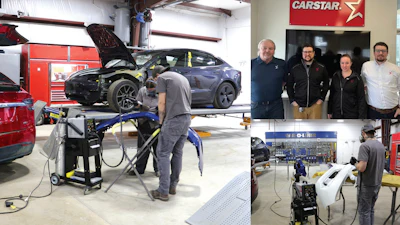
That thinking led the Don-Mor team to pursue Tesla certification, opening the door to a highly specific and growing segment of the market. From there, the shop expanded further, adding programs such as VinFast to broaden its capabilities and position itself for the future of electrified vehicles.
But certification is only one part of the equation.
The shift to EV repair required a deeper investment in training, infrastructure and process. Unlike traditional internal combustion repairs, EVs introduce highvoltage systems that demand specialized knowledge and strict safety protocols. Technicians need to understand how to safely disable high-voltage battery systems, how to assess damage in components that are often unfamiliar to traditional repairers, and how to follow manufacturer-specific procedures without deviation. There is no room for shortcuts.
At the same time, the physical shop environment had to evolve. Don-Mor invested in charging infrastructure to support diagnostics and repair workflows, ensuring vehicles can be powered safely while in the shop. High-voltage insulated tools and personal protective equipment became standard, not optional.
These types of investments are becoming increasingly common across the industry as more electrified vehicles enter repair bays. For Don-Mor, they were necessary steps to ensure the business could perform repairs safely and to OEM standards.
From a business standpoint, the move into EV repair has also proven to be a smart one. “This expansion has significantly contributed to our revenue growth and underscores our dedication to delivering premium automotive repair solutions,” Brown said.
Beyond revenue, EV certification creates access. Certified shops are positioned to service vehicles that uncertified facilities cannot, which creates a natural pipeline of work as more electric vehicles require collision repair.
That strategy fits into a broader pattern that has defined Don-Mor CARSTAR for decades. The business has consistently diversified its services to maintain control over production and stabilize revenue streams. Mechanical repair, OEM certifications and specialized capabilities have all been added over time to keep more work in-house.
“Thank goodness we diversified,” Morton said, reflecting on how the business has evolved and the challenges that come with operating in a rapidly changing industry.
Today, the Don-Mor campus operates almost like a self-contained repair hub. Multiple buildings and departments work together to move vehicles efficiently through the repair process. The scale of the operation even requires practical touches, including staff using golf carts to travel between buildings across the property.
That same philosophy of efficiency and adaptation now applies to electric vehicles. For Brown, getting started does not mean transforming everything at once. It means taking the right first steps and building from there.
“Installing an EV charging station and familiarizing yourself with EV operations are critical first steps,” he said.
From there, shops can begin assessing their readiness. Understanding local EV adoption trends is an important starting point. If more electric vehicles are entering the market, the need for qualified repair facilities will follow.
Investing in technician training early allows shops to build internal capability before pursuing certifications. Establishing the basic infrastructure ensures they can safely and efficiently handle EVs when they arrive. The good news is that the transition does not have to happen overnight. Shops can phase in training, equipment and processes as demand grows. What matters most is starting the process.
Electric vehicles still represent a smaller portion of the overall vehicle population, but that share is steadily increasing. As more EVs hit the road, the pressure on the repair industry to keep up will only grow.
For Don-Mor, that reality feels familiar.
Every major shift in the industry has come with its own learning curve, and every time, the approach has been the same: prepare early, invest in people and adapt to new technology as it emerges.
More than 40 years after opening its first shop, Don-Mor CARSTAR continues to operate with the same mindset that built the business in the first place.
The vehicles in the repair bays may look very different today, but the philosophy remains unchanged. Stay ahead of the curve, invest in training and infrastructure, and be ready for whatever the next generation of vehicles brings through the door.
INSTALLING AN EV CHARGING STATION AND FAMILIARIZING YOURSELF WITH EV OPERATIONS ARE CRITICAL FIRST STEPS. — DON-MOR CARSTAR