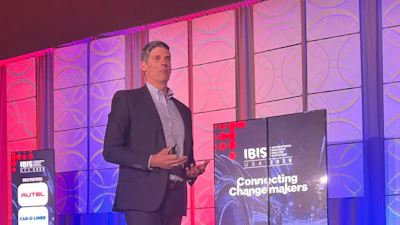

A burned dealership. An exploding battery shipment. Firefighters intentionally triggering thermal runaway events in electric vehicles. Dirk Fuchs did not waste time easing into his presentation at IBIS USA 2026. Instead, the Director of Engineering with the Energy Security Agency opened with real-world examples designed to send a clear message to collision repair leaders: the industry is moving into dangerous territory if shops fail to understand the realities of EV battery handling, storage and transportation.
Held this past April in Scottsdale, Arizona, IBIS USA brought together collision repair executives, insurers, OEM representatives and technology experts to discuss some of the most pressing issues facing the industry.
Drawing on his work with organizations including the National Transportation Safety Board and the National Fire Protection Association, Fuchs walked attendees through several investigations involving battery failures and thermal runaway incidents.
“I have the pleasure working with NTSB, for example, on federal investigations when things go wrong,” Fuchs told attendees. “So always when things go wrong, you can mostly count on that my head is somewhere around trying to find out what is the problem.”
One example involved a vehicle that arrived at a dealership with a battery fault code following a collision. According to Fuchs, the technician identified the issue late in the day, but the vehicle remained inside the building overnight.
“Everybody goes home,” he said. “What happens at 4 a.m. in the morning?”
Hours later, the dealership caught fire.
The presentation intensified when Fuchs described large-scale EV fire suppression testing conducted with NFPA using Rivian vehicles and battery packs intentionally pushed into thermal runaway conditions.
“We blew up batteries and vehicles,” Fuchs said. “Everybody claims they have the golden bullet for EV fires. Fire blankets, foam solutions, water application. We tested it all.”
Fuchs explained that lithium-ion batteries release dangerous gases during thermal runaway, including hydrogen and carbon monoxide, which can ignite violently once temperatures rise. “When this gas ignites, we have an explosion,” he explained.
At the same time, Fuchs pushed back against misconceptions surrounding EV fire frequency. According to statistics shared during the presentation, electric vehicles experience significantly fewer fires than combustion-powered vehicles and hybrids.
“On 100,000 electric vehicles, they have only 25 fires,” Fuchs explained. “Combustion engine vehicles are around 1,800 fires. Hybrids are around 2,500 fires.”
The biggest concern for repairers may be liability. Fuchs shared the story of a damaged battery that had been improperly tested and packaged before shipment following a collision. During transportation, the battery exploded inside the truck.
“The shop / packer became liable because the packer was not qualified,” he said.
Fuchs stressed that shops handling damaged EV batteries must comply with federal hazardous materials transportation rules under 49 CFR regulations, including certification requirements and proper testing procedures.
“There is a certification you have to do,” he explained. “It’s not a big deal, but you need those certifications.”
He also highlighted NFPA 855, a growing standard governing lithium-ion battery storage that is already being enforced in parts of California. Shops may soon face stricter requirements surrounding battery isolation, sprinkler systems and outdoor storage areas.
For many attendees, the presentation served as a clear warning that EV battery management is no longer a future concern for collision repairers. The risks, regulations and liabilities are already arriving at the shop door.
“Be aware,” Fuchs told the audience. “This is coming fast.”
This presentation was one of several thought-provoking discussions held during IBIS USA 2026. Over the coming months, Collision Repair magazine and EV Repair will continue bringing insights, interviews and coverage from the conference, highlighting the trends, technologies and challenges shaping the future of the collision repair industry.