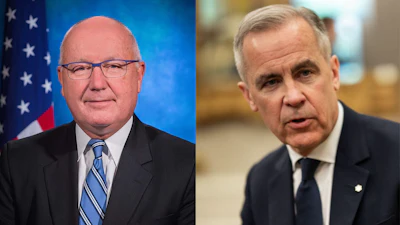
The United States will not allow Chinese-made electric vehicles entering Canada to cross into its market, U.S. Ambassador to Canada Pete Hoekstra said March 30, closing off a potential trans-border route created by Ottawa’s new trade agreement with Beijing.
“Those cars can come in from China, come into Canada, but they’re not going to cross the border into the US,” Hoekstra told Rebel News, citing national security concerns tied to data collection in connected vehicles.
The comments come as Canada formally activated its import framework on March 1, allowing up to 49,000 Chinese-built EVs annually at a reduced tariff rate of 6.1%, down from 106.1%.
Prime Minister Mark Carney reached the agreement with Chinese President Xi Jinping in January. The deal marked a sharp shift from Canada’s earlier alignment with U.S. trade policy, which had imposed a 100% surtax on Chinese EVs just 17 months prior.
In exchange, China agreed to lower tariffs on Canadian exports including canola, lobster, crab and peas, while committing to increased joint-venture investment in Canada’s auto manufacturing sector. The EV import quota is expected to rise to roughly 70,000 vehicles annually by 2031.
Despite Canada’s move, multiple U.S. barriers remain. A rule finalized by the United States Department of Commerce in January 2025 prohibits the import and sale of connected vehicles containing Chinese internet-connectivity hardware or software, with software restrictions beginning in model year 2027 and hardware measures to follow in 2029.
Chinese-built vehicles are also subject to combined U.S. tariffs exceeding 100% of their value and do not qualify for preferential treatment under the USMCA, eliminating any tariff advantage through Canada.
Automakers including BYD, Chery and Geely are preparing to enter the Canadian market as early as late 2026, targeting the mass-market segment with lower-cost EV offerings.
All three USMCA partners are expected to meet by July 1 under the agreement’s review provisions, as diverging approaches to China raise questions about the future alignment of North American trade policy.