Toronto, Ontario -- From autonomous ride-hailing technology to slowing electric vehicle sales and scaled-back manufacturing plans, recent developments highlight the shifting realities facing the automotive and mobility sectors. This roundup looks at Uber’s latest robotaxi reveal at CES, new data pointing to a decline in zero-emission vehicle sales in Canada and Ford Motor Co.’s decision to pull back from major EV investments tied to the Canadian market.
Robotaxis unveiled at CES
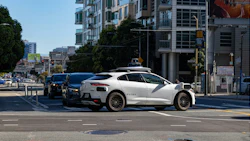
Uber has unveiled a custom-built robotaxi that it plans to integrate into its global ride-hailing platform.
The program will begin in San Francisco, a key market it shares with autonomous driving rival Waymo.
The new robotaxi is the product of a collaboration between Uber, autonomous driving technology company Nuro and electric vehicle manufacturer Lucid. The vehicle runs on a platform powered by artificial intelligence chips from Nvidia, a major player in autonomous and automotive computing. Uber and Nvidia announced late last year that they plan to deploy up to 100,000 robotaxis starting in 2027 as part of a long-term partnership.
Road testing of the robotaxis began last month, with human drivers seated behind the wheel as a safety measure.
Nvidia has been working with automakers to embed its technology in self-driving systems, strengthening its role in the autonomous vehicle sector. Uber’s robotaxi is based on the Lucid Gravity, an EV designed to carry up to six passengers.
The Gravity robotaxi features an Uber-designed in-cabin experience, including interactive screens that allow riders to adjust seat heaters, climate settings and music. Passengers can also contact support teams or instruct the vehicle to pull over if needed. The vehicle was showcased at an Nvidia exhibit at the Fontainebleau resort in Las Vegas.
Bumpy road expected for EV sales in 2026
More Canadians are buying new vehicles, according to the latest Statistics Canada data, but sales of zero-emission vehicles (ZEVs), including EVs, declined by 33.7% from 2024 to 2025.
The trend comes as uncertainty persists around trade tensions and tariff policies under U.S. President Donald Trump, while the federal government has signalled it is reconsidering its approach to electric vehicle sales mandates.
Statistics Canada reported on January 5, 2026, that 179,814 new vehicles were sold in July 2025, a modest increase from 177,313 units in June. Compared with the same month last year, July sales were up 6.8 per cent, following a 6.2% year-over-year gain in June.
Passenger vehicle sales rose more than 11 per cent in July, while truck sales increased by just over 6%.
In contrast, sales of ZEVs fell sharply. A total of 13,920 ZEVs were sold in July. ZEVs accounted for 7.7% of all new vehicle sales during the month, slightly lower than the 7.9% share reported in June.
Ford scales back EV strategy
Ford Motor Co.’s latest losses in its electric vehicle business are shedding light on why several major EV projects tied to Canada were cancelled or delayed, including plans at the automaker’s plant in Oakville, Ont.
Ford announced it would take a $19.5 billion charge on its EV business and scale back its electric vehicle strategy amid weak consumer demand. The automaker also ended production of its fully electric F-150 Lightning pickup truck.
The decision follows years of stalled EV investment plans in Canada. Ford had announced a $1.8 billion project in 2020 to transform its Oakville assembly plant into an electric SUV hub. That plan was scrapped last year, with the facility pivoting to $3 billion in conventional truck production.
Other automakers have also pulled back. General Motors ended production of electric delivery vans in Ingersoll, Ont., citing weak demand. Honda Canada postponed a $15-billion EV supply chain project in Alliston, Ont., while Stellantis delayed electric Dodge Charger production in Windsor, citing U.S. tariffs.
The slowdown has affected Canada’s battery supply chain, with Umicore delaying construction of its Kingston, Ont., EV battery plant. Volkswagen’s battery project in St. Thomas, Ont., remains active.
Ford has shifted its focus toward hybrid vehicles, saying hybrids, extended-range EVs and fully electric vehicles are expected to make up 50% of global volume by 2030.