In this week’s EV/AV report, federal policymakers, automakers and mobility platforms advance new strategies to accelerate the transition away from ICE vehicles while reshaping the autonomous landscape.
Canada Unveils Sweeping EV-Focused Automotive Strategy
On Feb. 5, 2026, Prime Minister Mark Carney introduced Canada’s updated automotive strategy in Vaughan, Ontario, positioning it as a national industrial blueprint aimed at securing long-term electric vehicle production and supply chain investment.
The strategy replaces the previous Electric Vehicle Availability Standard with outcomes-based greenhouse gas regulations targeting 75% zero-emission vehicle sales by 2035 and an aspirational 90% by 2040, giving automakers compliance flexibility while maintaining decarbonization objectives.
A five-year, $2.3 billion Electric Vehicle Affordability Program will provide up to $5,000 for battery electric and fuel-cell vehicles and up to $2,500 for plug-in hybrids, generally capped at vehicles under $50,000, with the cap waived for Canadian-assembled EVs to favour domestic production. Carney said the plan supports “next-generation vehicles built by Canadian workers,” linking climate ambition directly to industrial policy.
Infrastructure expansion forms a second pillar, including a $1.5 billion Canada Infrastructure Bank commitment to scale EV charging and hydrogen refuelling networks nationwide. The funding is structured to leverage private capital while targeting high-speed corridor charging and underserved rural regions.
Energy and Natural Resources Minister Tim Hodgson said Ottawa understands that “range anxiety makes it harder to choose an EV,” reinforcing that infrastructure access is central to adoption. Additional measures include up to $3 billion from the Strategic Response Fund and enhanced clean-technology tax incentives designed to attract battery manufacturing and critical mineral processing projects amid global competition.
Uber Commits US$100 Million to Autonomous EV Charging
On Feb. 18, 2026, Uber Technologies Inc. announced it will invest more than US$100 million to build high-capacity EV charging hubs in major U.S. metropolitan markets to support its expanding autonomous ride-hailing fleet.
The infrastructure push is designed to reduce vehicle downtime, improve fleet utilization and accelerate the commercial rollout of robotaxi services. The move reflects growing alignment between electrification and autonomous vehicle deployment, as large-scale AV networks depend on reliable charging ecosystems.
Uber CEO Dara Khosrowshahi said scalable charging capacity is “essential to realizing the full potential of autonomous and electric mobility,” underscoring infrastructure as a strategic priority rather than a supporting feature.
Tesla Produces First Purpose-Built Cybercab Robotaxi
On Feb. 17, 2026, Tesla produced the first Cybercab robotaxi at its Gigafactory in Austin, Texas, marking the debut of a purpose-built autonomous electric vehicle without pedals or a steering wheel.
Unlike prior Tesla vehicles adapted for assisted-driving features, the Cybercab is engineered specifically for ride-hailing use and high-volume autonomous deployment.
The milestone signals Tesla’s transition from consumer EV manufacturer toward mobility platform provider, though regulatory approvals for full driverless operation remain ongoing.
CEO Elon Musk said the Cybercab is designed around “full autonomy and affordability,” highlighting cost reduction and simplified production architecture as core objectives.
Waymo Introduces Sixth-Generation Robotaxi Platform
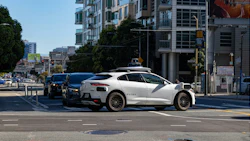
In early February 2026, Waymo unveiled its sixth-generation autonomous vehicle platform in the United States, featuring redesigned sensors, consolidated hardware architecture and lower production costs intended to support large-scale deployment.
The updated system is engineered to operate more reliably in adverse weather conditions, a key technical hurdle for broader North American expansion including colder climates. The company emphasized manufacturing efficiency and sensor optimization as necessary steps toward sustainable commercial autonomy.
Waymo co-CEO Dmitri Dolgov described the platform as ready for “high-volume production,” signalling confidence in its readiness for scaled operations.