
Europe's electric vehicle market has reached 16.1 percent of new car registrations, with hybrid-electric vehicles accounting for 34.7 percent, signaling a fundamental shift that Canadian collision repair shops should prepare for through OEM certification, equipment upgrades, and technician retraining.
- Battery-electric vehicles now represent 16.1 percent of European new car registrations, up from 13.1 percent a year earlier
- Hybrid-electric vehicles dominate with 34.7 percent market share, while petrol and diesel combined dropped to only 37 percent
- In the first nine months of 2025, 1.3 million battery-electric cars were registered across the EU, with Germany showing 38.3 percent growth
- Canada's federal mandate requires all new light-duty vehicles to be zero-emission by 2035, mirroring Europe's trajectory
- Canadian collision repair shops must invest in OEM certification, advanced electrical training, and EV-ready infrastructure to remain competitive as electric vehicles dominate the market
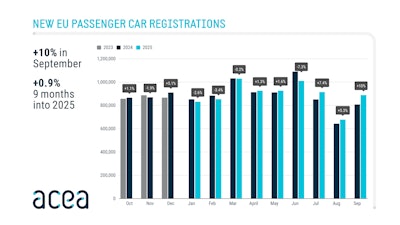
Brussels, Belgium -- Europe’s automotive market continues to move swiftly toward electrification. According to a release from the European Automobile Manufacturers’ Association (ACEA), battery-electric vehicles now account for 16.1 percent of all new registrations, up from 13.1 percent a year earlier
Hybrid-electric vehicles have taken an even greater share, representing 34.7 percent of the market, while plug-in hybrids have risen to nine percent — their seventh straight month of gains. Meanwhile, petrol and diesel together make up only 37 percent, down from nearly 47 percent in 2024.
That marks a fundamental turning point for European automakers — and a glimpse into what’s ahead for Canadian bodyshops.
In the first nine months of 2025, 1.3 million battery-electric cars were registered across the EU. Growth was especially strong in Germany (+38.3 percent), Belgium (+12.4 percent), and the Netherlands (+3.9 percent), while France saw only a slight decline despite rebounding in September
At the same time, traditional engines are slipping into decline. Petrol car registrations dropped 18.7 percent, diesel fell 24.7 percent, and every major European market saw losses. France was hardest hit, down nearly a third.
Automakers leading this surge — including the Volkswagen Group, Renault, and BMW — have been aggressively expanding their electrified lineups, with newer entrants like BYD and SAIC Motor also gaining ground
What It Means for Canada
Europe has long been a bellwether for automotive trends. From diesel adoption to small-car design to ADAS integration, Canadian markets typically follow Europe’s lead within a few years — and the EV transition appears to be no different.
Canadian dealers and fleets are already reporting similar shifts in demand, with federal mandates pushing for all new light-duty vehicles to be zero-emission by 2035. For collision repairers, that means the cars entering bays over the next decade will increasingly feature high-voltage systems, lightweight materials, and complex calibration requirements.
Shops that adapt early — through OEM certification, equipment upgrades, and technician retraining — will have a decisive advantage. The alternative is being left behind as EVs begin to dominate urban markets, insurance networks, and manufacturer programs.
While full battery-electric models are growing, hybrids remain the dominant technology across Europe. Their 34.7 percent market share shows that consumers still value flexibility during the transition. This mirrors Canada’s current path, where plug-in hybrids are helping bridge the gap for drivers not yet ready to commit to full electrification.
For repairers, this dual demand means maintaining both traditional mechanical expertise and advanced electrical knowledge. It’s a tall order — but one that defines the future of the trade.
Preparing for the Future
Europe’s data paints a clear picture: the internal combustion engine’s dominance is ending. As one in every six new European cars sold is now electric, Canada’s collision sector must evolve in parallel.
Bodyshops that start investing in training, safety protocols, and EV-ready infrastructure today will be ready when those same models begin appearing on Canadian roads — and eventually, in Canadian repair bays.
The future isn’t just coming, it’s charging in.