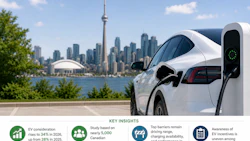
Electric vehicle sales continue to climb in Canada, signalling a future that collision repairers can no longer afford to ignore.
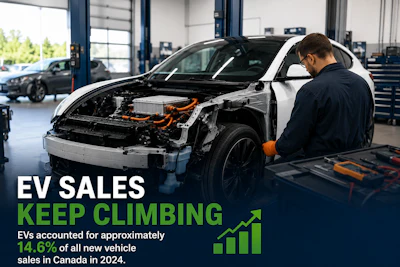
New data shows that Canadians purchased more than 264,000 zero-emission vehicles in 2024, representing approximately 14.6 per cent of all new vehicle registrations across the country. The figure marks another significant step forward in Canada's transition toward electrified transportation and continues a growth trend that has steadily reshaped the automotive market over the past decade.
While headlines often focus on consumer adoption, government incentives and charging infrastructure, the growing number of EVs on Canadian roads carries major implications for the collision repair industry.
According to Statistics Canada, EV sales strengthened throughout 2024, reaching their highest monthly levels in September as new models entered the marketplace. More than $17 billion worth of zero-emission vehicles were sold during the year.
The growth is not evenly distributed across the country. Quebec remains Canada's EV leader, with British Columbia continuing to post strong adoption rates. Ontario has also experienced steady growth as consumers gain access to more vehicle choices and improved charging infrastructure.
The broader trend suggests electrification is becoming a permanent part of Canada's vehicle fleet. Just a few years ago, zero-emission vehicles accounted for roughly one in 10 new vehicle sales. Today, they represent nearly one in seven. Industry observers expect that percentage to continue increasing as automakers expand their electric offerings and governments pursue ambitious emissions reduction targets.
For collision repairers, these numbers represent more than a sales statistic.
Every new EV sold today becomes a future repair opportunity. Unlike conventional vehicles, electric vehicles often require specialized repair procedures, dedicated tooling, high-voltage safety training and access to manufacturer repair information. Many also incorporate advanced driver assistance systems, battery protection structures and lightweight materials that can significantly alter repair planning and execution.
As EV market share grows, shops that invest in training, equipment and proper repair processes will be better positioned to handle an expanding segment of the vehicle population. Those that delay may find themselves turning away work or struggling to meet OEM requirements and customer expectations.
The trend also extends beyond repair procedures. Insurers, fleet operators and consumers are increasingly seeking repair facilities capable of safely handling high-voltage vehicles. Certification programs and EV-specific training are becoming important differentiators in many markets.
The growing EV population is also expected to influence parts sourcing, estimating practices and total loss calculations. Battery condition assessments, thermal event protocols and post-collision diagnostic procedures are becoming routine considerations in repairs that would have been straightforward only a few years ago.
For an industry built around adapting to vehicle technology, the continued rise of EV sales reinforces a simple reality. Electric vehicles are no longer a niche market. They are becoming a mainstream part of Canada's vehicle fleet, and the collision repair industry must continue evolving alongside them.
The vehicles arriving in dealerships today will be arriving in bodyshops tomorrow.