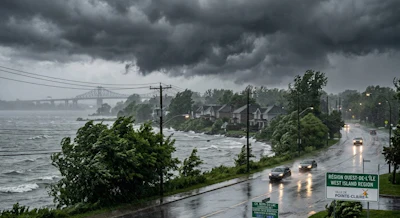
Insured losses from June flooding in Montreal and surrounding communities have reached $442 million as of September 2024, representing a $31 million increase from initial estimates due to additional residential and commercial property damage discovered 90 days after the event.
- Insured losses from June Montreal flooding totaled $442 million as of September 22, 2024
- The estimate increased by $31 million from CatIQ's initial $411 million figure due to additional residential and commercial property claims
- Pluvial flash flooding occurred when intense rainfall overwhelmed drainage systems, with six similar catastrophes recorded in Ontario and Quebec between June and August
- The 2024 flooding events generated more than 30,000 personal property claims across Ontario and Quebec
- CatIQ will release its next estimate for Montreal flooding on December 22, six months after the event
Insured losses from June flooding in Montreal and surrounding communities have risen to $442 million.
Catastrophe Indices and Quantification Inc. released the updated estimate on Sept. 22. CatIQ is a Toronto-based provider of Canadian catastrophe insurance data.
The estimate covers residential property, commercial property and vehicle claims from flooding in Montreal’s West Island and surrounding areas. CatIQ did not disclose the number of vehicle claims or their share of the $442-million total.
The latest figure represents conditions 90 days after the flooding. It is $31 million higher than CatIQ’s initial estimate of $411 million.
CatIQ attributed the increase to additional residential and commercial property losses. That means the higher estimate should not be interpreted as evidence of an increase in vehicle claims.
The overall losses have not produced a noticeable weather-related increase at Walid Auto Body, a collision repair facility in L’Île-Bizard.
Wesam Abunowara, the shop’s second-generation owner and operator, said business has remained steady.
“To be honest, we haven’t seen a major pickup as a result of the weather, but things have been very consistent and busy in the two years I’ve been here,” Abunowara said.
His experience shows why the combined loss figure cannot be used as an estimate of collision repair activity. The total includes damage to homes and businesses, and CatIQ has not separated the automotive portion.
“In many ways, pluvial flash flooding events were the story of the summer in terms of Canadian catastrophes,” CatIQ director Caroline Floyd said.
Pluvial flooding occurs when intense rainfall overwhelms drainage systems before the water can run off or soak into the ground.
CatIQ recorded six catastrophes dominated by rain-driven flooding and sewer backup in Ontario and Quebec between June and August. Those events produced more than 30,000 personal property claims.
Only one comparable event was recorded during the same period in 2025. CatIQ said 2024 remained an exceptional year, when major flooding in southern Ontario and the remnants of Hurricane Debby in southern Quebec generated nearly 100,000 personal property claims.
CatIQ plans to release its next estimate for the Montreal flooding on Dec. 22, six months after the event.