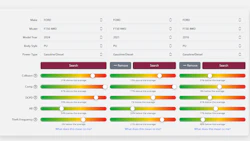
Auto insurance costs can vary widely across diesel, gasoline, hybrid and electric vehicles, according to new data from Rates.ca. While several diesel pickup trucks rank among the least expensive vehicles to insure, a number of EVs continue to sit at the higher end of the pricing spectrum.
Looking at 2025 model-year vehicles, the Ford F-250 Super Duty carries an average annual insurance premium of about $1,706. By comparison, the Hyundai Ioniq 5 is estimated at roughly $4,342 per year, while the Tesla Model Y comes in at approximately $3,014.
The difference highlights how insurance costs are becoming an increasingly important part of overall vehicle ownership, particularly as more consumers weigh the long-term affordability of EVs against traditional internal combustion models.
According to Rates.ca, insurers are not pricing vehicles based solely on fuel type. Premiums are also influenced by repair costs, theft rates, claims history and how a specific model is classified. For EVs, higher repair costs remain one of the biggest drivers of elevated insurance pricing.
The Rates.ca data shows diesel vehicles generally posted the lowest annual premiums. The Ford F-250 Super Duty led the list at $1,706, followed by the Chevrolet Silverado 1500 at $1,813 and the Ram 2500 at $3,749.
Gasoline-powered vehicles landed between diesel and electric models. The Ford F-150 averaged $2,359 per year, while the Toyota Corolla came in at $3,255 and the Honda Civic at $4,032.
Among EVs, the Tesla Model Y averaged $3,014 annually, followed closely by the Chevrolet Equinox EV at $3,026. The Hyundai Ioniq 5 ranked among the most expensive vehicles to insure at $4,342.
For the collision repair sector, the numbers reinforce a trend that has become increasingly clear over the past several years: EVs remain more expensive to repair. Higher parts costs, specialized repair procedures, battery-related safety requirements and limited access to aftermarket components can all increase claim severity.
Even relatively minor collisions can become more expensive when a vehicle requires battery inspections, high-voltage system isolation or OEM-mandated replacement of structural components near the battery pack. In some cases, insurers have also reported higher total loss rates for EVs because repair costs can quickly exceed vehicle value.
That has direct implications for repairers. Shops that are properly equipped to repair EVs may continue to see higher average repair values and more insurer scrutiny around estimates, documentation and OEM procedures. At the same time, insurers may increasingly steer EV repairs toward certified facilities with the right training and equipment in place.
The broader takeaway is that EV ownership costs extend beyond the purchase price. For consumers, insurance premiums are becoming a bigger part of the equation. For repairers, those higher premiums reflect the growing complexity—and opportunity—within the EV repair market.